El papel de TVET en el desarrollo de habilidades verdes para lograr un crecimiento económico sostenible en Ghana
DOI:
https://doi.org/10.52428/27888991.v7i11.1461Palabras clave:
Empleabilidad, SDG 4: Educación de calidad, SDG 8: Trabajo decente y crecimiento económico, SDG 9: Industria, innovación e infraestructura, Educación y Formación Técnica y ProfesionalResumen
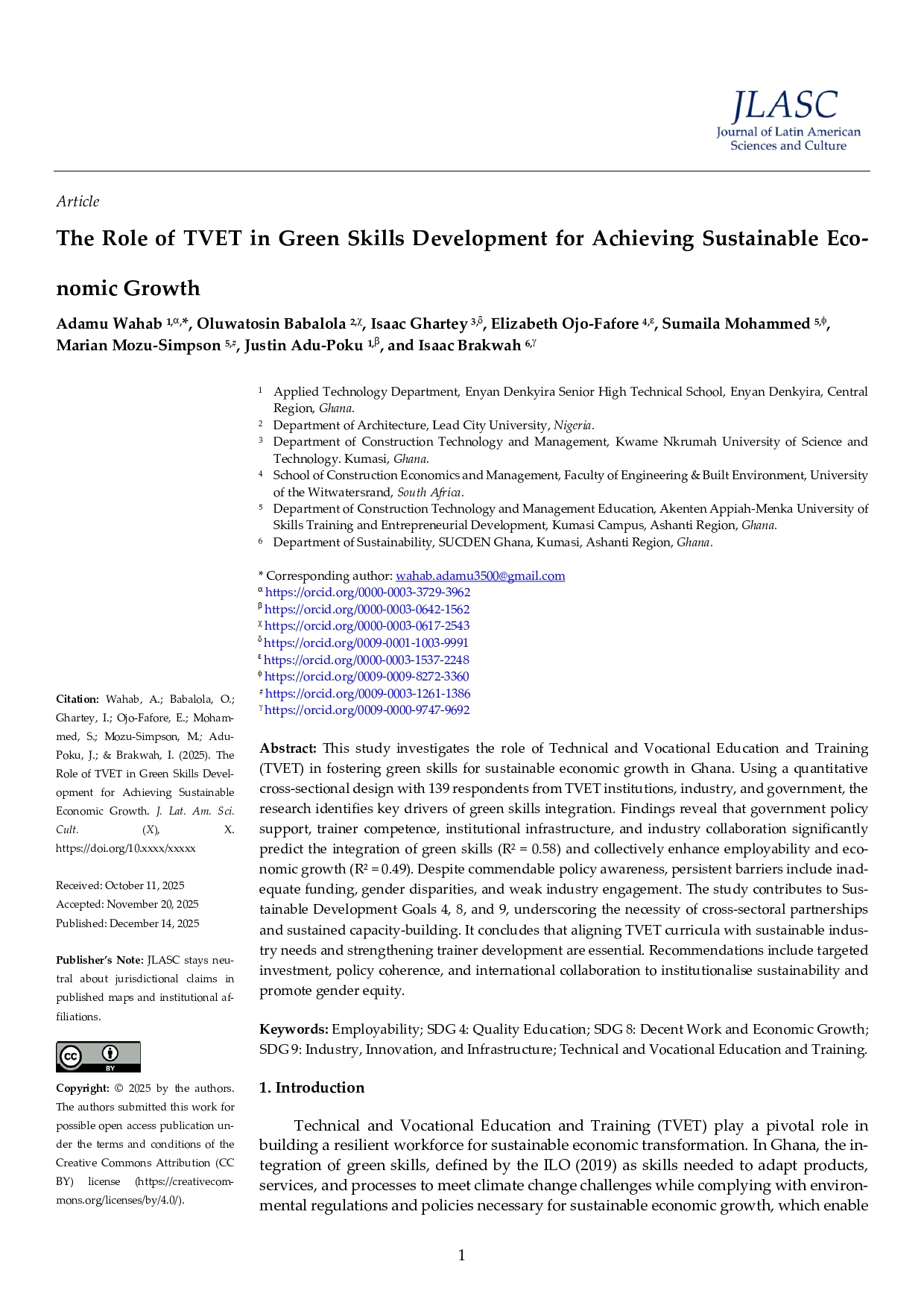
Este estudio investiga el papel de la Educación y Formación Técnica y Profesional (EFTP) en la promoción de habilidades verdes para un crecimiento económico sostenible en Ghana. La investigación adopta un diseño cuantitativo transversal que incluyó a 139 participantes provenientes de instituciones de EFTP, socios de la industria y agencias gubernamentales. Los resultados indican que el apoyo de las políticas gubernamentales, la competencia de los formadores, la infraestructura institucional y la colaboración con la industria son predictores significativos de la integración de habilidades verdes (R² = 0,58) y, en conjunto, mejoran la empleabilidad y el crecimiento económico (R² = 0,49). Aunque la conciencia política y la preparación institucional son destacables, las barreras persistentes, como la financiación insuficiente, las disparidades de género y la débil participación de la industria, continúan limitando la transformación sistémica.
Este estudio contribuye de manera significativa a los Objetivos de Desarrollo Sostenible (ODS) 4 (Educación de Calidad), 8 (Trabajo Decente y Crecimiento Económico) y 9 (Industria, Innovación e Infraestructura). Resalta la necesidad de asociaciones intersectoriales y de fortalecimiento continuo de capacidades para garantizar una transición verde inclusiva. Concluye que alinear los planes de estudio de la EFTP con las necesidades sostenibles de la industria y fortalecer la formación de los docentes son aspectos esenciales para alcanzar las aspiraciones de Ghana hacia una economía verde. El estudio recomienda inversiones focalizadas, coherencia política y colaboración internacional para institucionalizar la sostenibilidad dentro de los sistemas de EFTP y promover la equidad de género en los campos técnicos.
Descargas
Referencias
Addaney, M., Kusi, C., Akudugu, J. A., Annan, J. K., Aniah, E., & Appiah, A. O. (2025). Stakeholders’ perception of inclusive and quality technical and vocational education training in the Sunyani municipality of Ghana. International Journal of Higher Education and Sustain-ability, 5(3), 180–198. https://doi.org/10.1504/ijhes.2025.147638
Ahmadu, N. D., & Orisaremi, J. O. (2025, August 23). Technical and Vocational Education and Training (TVET) as a catalyst for sustainable development in Nigeria. Covenant Journal of Education. https://journals.covenantuniversity.edu.ng/index.php/cjoe/article/view/5207
Ahmed, A., Shakeel, M., & Khan, A. H. (2021). Tracing the institutional role of technical and vocational education and training skills for the socio-economic development of women in Baluchistan. Pakistan Journal of Education, 38(1). https://doi.org/10.30971/pje.v38i1.1391
Albertz, A., & Pilz, M. (2025). Green alignment, green vocational education and training, green skills, and related subjects: A literature review on actors, contents, and regional contexts. International Journal of Training and Development. https://doi.org/10.1111/ijtd.1235
Alhassan, H., Osei, M., Asinyo, B. K., & Ofori, E. A. (2024). Teacher college of education trainees’ perception of the contribution of TVET to socio-economic development: The case of Tamale College of Education. Cogent Education, 11(1). https://doi.org/10.1080/2331186x.2024.2393493
Busemeyer, M. R., Carstensen, M. B., Kemmerling, A., & Tosun, J. (2025). Foundations for a green economy: How institutions shape green skills. NPJ Climate Action, 4(1). https://doi.org/10.1038/s44168-025-00234-5
Chola, R. M., & Kiplagat, H. (2025). Contribution of TVET to sustainable development. http://41.89.164.27:8080/xmlui/han-dle/123456789/2407
Commission for Technical and Vocational Education and Training (CTVET). (2025). Advancing sustainability in TVET: CTVET’s role in the greening TVET validation workshop. Retrieved September 13, 2025, from https://ctvet.gov.gh/advancing-sustainability-in-tvet-ctvets-role-in-the-greening-tvet-validation-workshop/
European Centre for the Development of Vocational Training (Cedefop). (2021). Green skills and environmental awareness in vocational education and training. Retrieved September 13, 2025, from https://www.cedefop.europa.eu/files/5524_en.pdf
International Labour Organisation (ILO). (2019). Skills for a greener future: A global view. Retrieved September 13, 2025, from https://www.ilo.org/publications/skills-greener-future-global-view
Joseph, O. B., Olateji, M., Ijiga, O. M., Okoli, I., & Frempong, D. (2025). Future-proofing skills in the Global South: Strategic directions for transforming Technical and Vocational Education and Training (TVET). Deleted Journal, 5(2), 2478–2492. https://doi.org/10.62225/2583049x.2025.5.2.4730
Morley, S. (2025). Green Skills in TVET: Preparing for Sustainable Job. Retrieved on 30 Nov. 2025, from https://www.worldoftvet.com/blog/green-skills-in-tvet-preparing-for-sustainable-jobs
Liu, Y., & Chen, Y. (2025). Exploring the role of vocational education in promoting global sustainable development. Vocational and Technical Education. https://doi.org/10.1515/wvte-2025-2002
Ogur, E. O. (2023). TVET, economy and sustainable development. International Journal of Vocational and Technical Education, 15(2), 12–17. https://doi.org/10.5897/ijvte2022.0315
Owusu-Agyeman, Y. (2025). Microlearning for green skills development in Ghana: A pathway to sustainability and just transitions. Interna-tional Journal of Training and Development. https://doi.org/10.1111/ijtd.12356
Owusu-Agyeman, Y., & Aryeh-Adjei, A. A. (2023). The development of green skills for the informal sector of Ghana: Towards sustainable futures. Journal of Vocational Education and Training, 76(2), 406–429. https://doi.org/10.1080/13636820.2023.2238270
Owusu-Agyeman, Y., Brenya, B., Kwapong, O. A. T. F., & Abrefa-Gyan, T. (2024). Teacher perceptions about the reputation of technical and vocational education and training in Ghana. Education + Training, 67(3), 361–388. https://doi.org/10.1108/et-10-2023-0446
Pachatz, W., Bernsteiner, R., Probst, A., & Ploder, C. (2025). Green transition in vocational education – The Austrian way. INTED Pro-ceedings, 1, 820–827. https://doi.org/10.21125/inted.2025.0300
Paryono, N. (2017). The importance of TVET and its contribution to sustainable development. AIP Conference Proceedings. https://doi.org/10.1063/1.5003559
Pujun, C. (2025). Green skills in coordination vocational education: A comparative study of curriculum integration in China and Germany. International Journal of Training and Development. https://doi.org/10.1111/ijtd.12348
Thake, A. M. (2024). Transitioning to a green economy: The impact on the labour market and workforce skills. In Elsevier eBooks (pp. 163–175). https://doi.org/10.1016/b978-0-443-23603-7.00013-3
Tramonti, M., & Dochshanov, A. M. (2025). Greenteach: Integrating sustainability into vocational education and training. EDULEARN Proceedings, 1, 828–833. https://doi.org/10.21125/edulearn.2025.0296
United Nations Environment Programme (UNEP). (2025). Green Economy. Retrieved on 30 Nov. 2025, from https://www.unep.org/re-gions/asia-and-pacific/regional-initiatives/supporting-resource-efficiency/green-economy
UNESCO-UNEVOC. (2020). Greening technical and vocational education and training: A practical guide. Retrieved September 13, 2025, from https://unevoc.unesco.org/home/SDGs+and+Greening+TVET
World of TVET. (2025). Green skills in TVET: Preparing for sustainable jobs. Retrieved September 13, 2025, from https://www.worldoftvet.com/blog/green-skills-in-tvet-preparing-for-sustainable-jobs
Descargas
Publicado
Número
Sección
Licencia
Derechos de autor 2025 Adamu Wahab, Ghartey Isaac, Elizabeth Ojo-Fafore, Oluwatosin Babalola, Sumaila Mohammed, Marian Mozu-Simpson, Justin Adu-Poku, Isaac Brakwah

Esta obra está bajo una licencia internacional Creative Commons Atribución 4.0.
Authors who publish in this journal agree to the following conditions: Authors retain copyright and grant the journal the right of first publication, with the work licensed under a Creative Commons Attribution 4.0 International License, which allows others to use the published work provided they acknowledge the authorship and initial publication in this journal. Authors may enter into separate, additional contractual agreements for the non-exclusive distribution of the version of the article published in this journal (e.g., posting it to an institutional repository or publishing it in a book), provided they clearly indicate that the work was first published in this journal. Authors are permitted and encouraged to share their work online (e.g., in institutional repositories or on personal websites) before and during the manuscript submission process, as this can lead to productive exchanges and increased and faster citation of the published work.
Cómo citar