The Role of TVET in Green Skills Development for Achieving Sustainable Economic Growth in Ghana
DOI:
https://doi.org/10.52428/27888991.v7i11.1461关键词:
Employability, SDG 4: Quality Education, SDG 8: Decent Work and Economic Growth, SDG 9: Industry, Innovation, and Infrastructure, Technical and Vocational Education and Training摘要
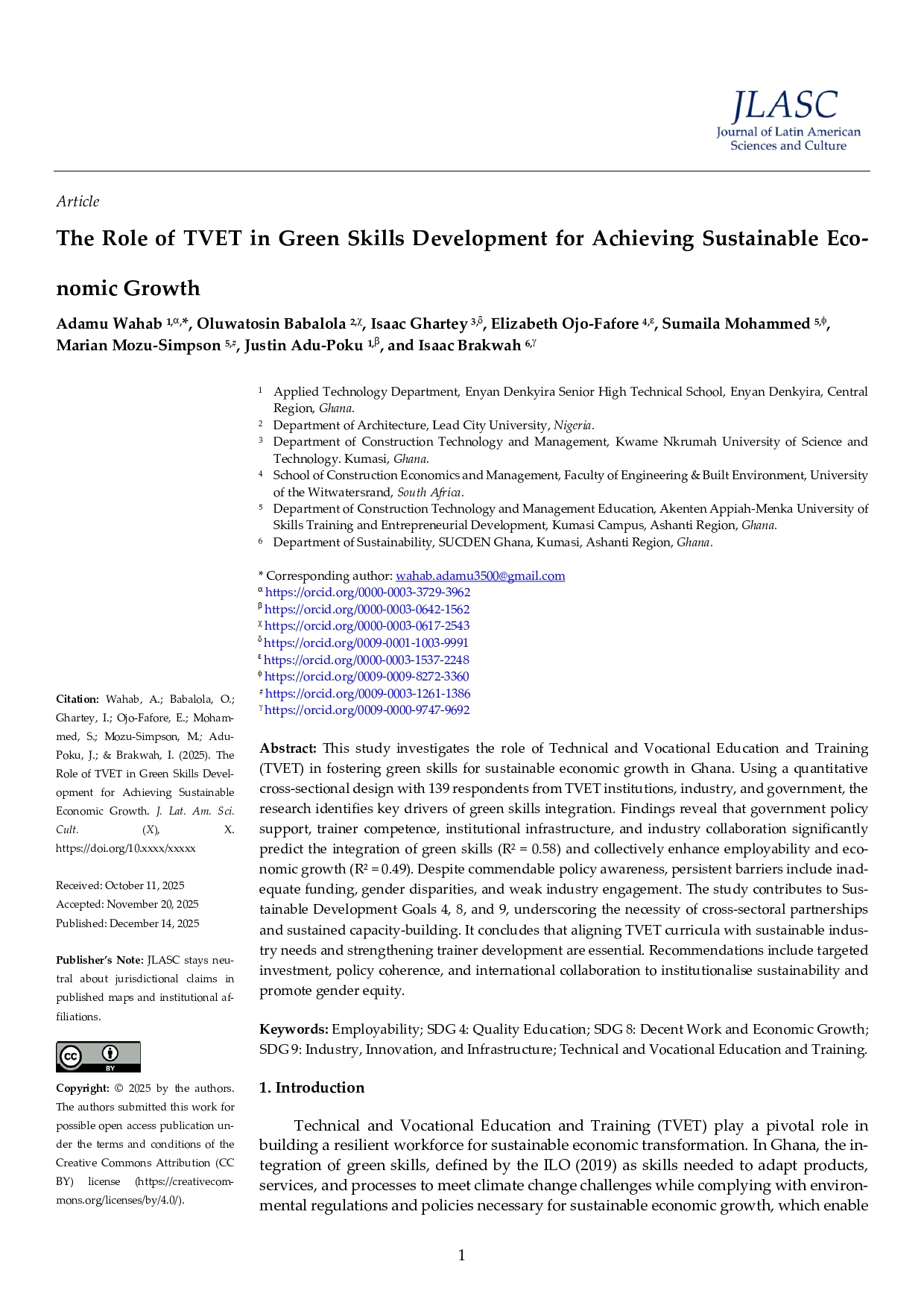
This study investigates the role of Technical and Vocational Education and Training (TVET) in fostering green skills for sustainable economic growth in Ghana. The study adopts a quantitative cross-sectional design involving 139 respondents drawn from TVET institutions, industry partners, and government agencies. Findings indicate that government policy support, trainer competence, institutional infrastructure, and industry collaboration significantly predict the integration of green skills (R² = 0.58) and collectively enhance employability and economic growth (R² = 0.49). Although policy awareness and institutional readiness are commendable, persistent barriers such as inadequate funding, gender disparities, and weak industry engagement continue to constrain systemic transformation. This study significantly contributes to the global Sustainable Development Goals (SDGs) 4 (Quality Education), 8 (Decent Work and Economic Growth), and 9 (Industry, Innovation, and Infrastructure). The study underscores the necessity of cross-sector partnerships and sustained capacity-building to ensure an inclusive green transition. It concludes that aligning TVET curricula with sustainable industry needs and strengthening trainer development are essential to achieving Ghana's green economy aspirations. The study recommends targeted investments, policy coherence, and international collaboration to institutionalize sustainability within TVET systems and promote gender equity across technical fields.
Downloads
参考
Addaney, M., Kusi, C., Akudugu, J. A., Annan, J. K., Aniah, E., & Appiah, A. O. (2025). Stakeholders’ perception of inclusive and quality technical and vocational education training in the Sunyani municipality of Ghana. International Journal of Higher Education and Sustainability, 5(3), 180–198. https://doi.org/10.1504/ijhes.2025.147638
Ahmadu, N. D., & Orisaremi, J. O. (2025, August 23). Technical and Vocational Education and Training (TVET) as a catalyst for sustainable development in Nigeria. Covenant Journal of Education. https://journals.covenantuniversity.edu.ng/index.php/cjoe/article/view/5207
Ahmed, A., Shakeel, M., & Khan, A. H. (2021). Tracing the institutional role of technical and vocational education and training skills for the socio-economic development of women in Baluchistan. Pakistan Journal of Education, 38(1). https://doi.org/10.30971/pje.v38i1.1391
Albertz, A., & Pilz, M. (2025). Green alignment, green vocational education and training, green skills and related subjects: A literature review on actors, contents and regional contexts. International Journal of Training and Development. https://doi.org/10.1111/ijtd.12359
Alhassan, H., Osei, M., Asinyo, B. K., & Ofori, E. A. (2024). Teacher colleges of education trainees’ perception of the contribution of TVET to socio-economic development: The case of Tamale College of Education. Cogent Education, 11(1). https://doi.org/10.1080/2331186x.2024.2393493
Busemeyer, M. R., Carstensen, M. B.,
Kemmerling, A., & Tosun, J. (2025). Foundations for a green economy: How institutions shape green skills. NPJ Climate Action, 4(1). https://doi.org/10.1038/s44168-025-00234-5
Chola, R. M., & Kiplagat, H. (2025). Contribution of TVET to sustainable development. http://41.89.164.27:8080/xmlui/handle/123456789/2407
Commission for Technical and Vocational Education and Training (CTVET). (2025). Advancing sustainability in TVET: CTVET’s role in the greening TVET validation workshop. Retrieved September 13, 2025, from https://ctvet.gov.gh/advancing-sustainability-in-tvet-ctvets-role-in-the-greening-tvet-validation-workshop/
European Centre for the Development of Vocational Training (Cedefop). (2021). Green skills and environmental awareness in vocational education and training. Retrieved September 13, 2025, from https://www.cedefop.europa.eu/files/5524_en.pdf
International Labour Organisation (ILO). (2019). Skills for a greener future: A global view. Retrieved September 13, 2025, from https://www.ilo.org/publications/skills-greener-future-global-view
Joseph, O. B., Olateji, M., Ijiga, O. M., Okoli, I., & Frempong, D. (2025). Future-proofing skills in the Global South: Strategic directions for transforming Technical and Vocational Education and Training (TVET). Deleted Journal, 5(2), 2478–2492. https://doi.org/10.62225/2583049x.2025.5.2.4730
Liu, Y., & Chen, Y. (2025). Exploring the role of vocational education in promoting global sustainable development. Vocational and Technical Education. https://doi.org/10.1515/wvte-2025-2002
Ogur, E. O. (2023). TVET, economy and sustainable development. International Journal of Vocational and Technical Education, 15(2), 12–17. https://doi.org/10.5897/ijvte2022.0315
Owusu‐Agyeman, Y. (2025). Microlearning for green skills development in Ghana: A pathway to sustainability and just transitions. International Journal of Training and Development. https://doi.org/10.1111/ijtd.12356
Owusu-Agyeman, Y., & Aryeh-Adjei, A. A. (2023). The development of green skills for the informal sector of Ghana: Towards sustainable futures. Journal of Vocational Education and Training, 76(2), 406–429. https://doi.org/10.1080/13636820.2023.2238270
Owusu-Agyeman, Y., Brenya, B., Kwapong, O. A. T. F., & Abrefa-Gyan, T. (2024). Teacher perceptions about the reputation of technical and vocational education and training in Ghana. Education + Training, 67(3), 361–388. https://doi.org/10.1108/et-10-2023-0446
Pachatz, W., Bernsteiner, R., Probst, A., & Ploder, C. (2025). Green transition in vocational education – The Austrian way. INTED Proceedings, 1, 820–827. https://doi.org/10.21125/inted.2025.0300
Paryono, N. (2017). The importance of TVET and its contribution to sustainable development. AIP Conference Proceedings. https://doi.org/10.1063/1.5003559
Pujun, C. (2025). Green skills in logistics vocational education: A comparative study of curriculum integration in China and Germany. International Journal of Training and Development. https://doi.org/10.1111/ijtd.12348
Thake, A. M. (2024). Transitioning to a green economy: The impact on the labour market and workforce skills. In Elsevier eBooks (pp. 163–175). https://doi.org/10.1016/b978-0-443-23603-7.00013-3
Tramonti, M., & Dochshanov, A. M. (2025). Greenteach: Integrating sustainability into vocational education and training. EDULEARN Proceedings, 1, 828–833. https://doi.org/10.21125/edulearn.2025.0296
UNESCO-UNEVOC. (2020). Greening technical and vocational education and training: A practical guide. Retrieved September 13, 2025, from https://unevoc.unesco.org/home/SDGs+and+Greening+TVET
World of TVET. (2025). Green skills in TVET: Preparing for sustainable jobs. Retrieved September 13, 2025, from https://www.worldoftvet.com/blog/green-skills-in-tvet-preparing-for-sustainable-jobs
已出版
How to Cite
期
栏目
License
Copyright (c) 2025 Adamu Wahab, Ghartey Isaac, Elizabeth Ojo-Fafore, Oluwatosin Babalola, Sumaila Mohammed, Marian Mozu-Simpson, Justin Adu-Poku, Isaac Brakwah

This work is licensed under a Creative Commons Attribution 4.0 International License.
Los autores/as que publiquen en esta revista aceptan las siguientes condiciones: Los autores/as conservan los derechos de autor y ceden a la revista el derecho de la primera publicación, con el trabajo registrado con la licencia de atribución de Creative Commons 4.0, que permite a terceros utilizar lo publicado siempre que mencionen la autoría del trabajo y a la primera publicación en esta revista. Los autores/as pueden realizar otros acuerdos contractuales independientes y adicionales para la distribución no exclusiva de la versión del artículo publicado en esta revista (p. ej., incluirlo en un repositorio institucional o publicarlo en un libro) siempre que indiquen claramente que el trabajo se publicó por primera vez en esta revista. Se permite y recomienda a los autores/as a compartir su trabajo en línea (por ejemplo: en repositorios institucionales o páginas web personales) antes y durante el proceso de envío del manuscrito, ya que puede conducir a intercambios productivos, a una mayor y más rápida citación del trabajo publicado.