Construcción de capacidades a través de las redes tecnológicas y científicas
DOI:
https://doi.org/10.52428/27888991.v7i10.1299Palabras clave:
Desarrollo tecnológico, Tecnologías del aprendizaje, Capacidades tecnológicas, TIC, Innovación científica, Aprendizaje significativoResumen
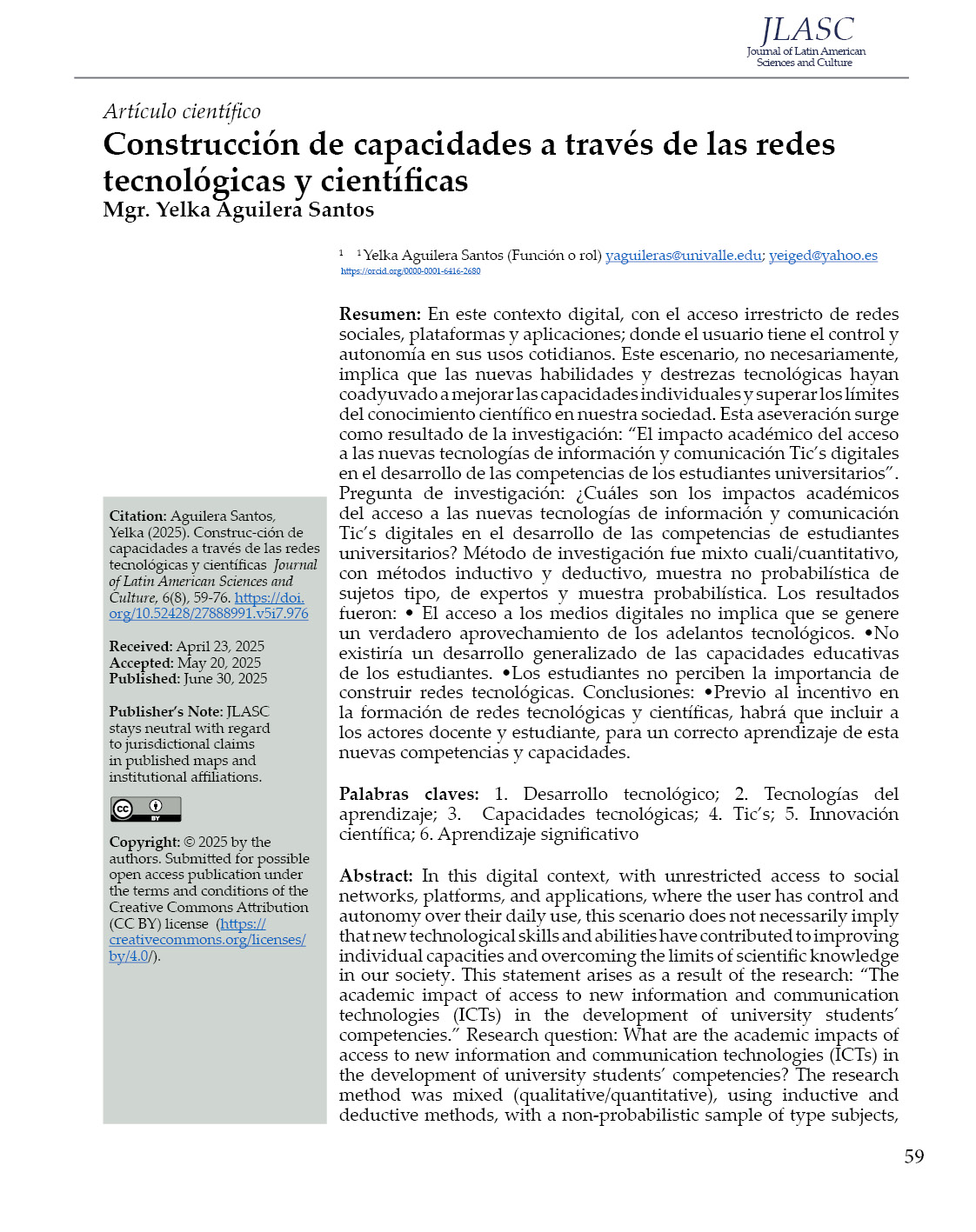
En este contexto digital, con el acceso irrestricto de redes sociales, plataformas y aplicaciones; donde el usuario tiene el control y autonomía en sus usos cotidianos. Este escenario, no necesariamente, implica que las nuevas habilidades y destrezas tecnológicas hayan coadyuvado a mejorar las capacidades individuales y superar los límites del conocimiento científico en nuestra sociedad. Esta aseveración surge como resultado de la investigación: “El impacto académico del acceso a las nuevas tecnologías de información y comunicación Tic’s digitales en el desarrollo de las competencias de los estudiantes universitarios”. Pregunta de investigación: ¿Cuáles son los impactos académicos del acceso a las nuevas tecnologías de información y comunicación Tic’s digitales en el desarrollo de las competencias de estudiantes universitarios? Método de investigación fue mixto cuali/cuantitativo, con métodos inductivo y deductivo, muestra no probabilística de sujetos tipo, de expertos y muestra probabilística. Los resultados fueron: • El acceso a los medios digitales no implica que se genere un verdadero aprovechamiento de los adelantos tecnológicos. •No existiría un desarrollo generalizado de las capacidades educativas de los estudiantes. •Los estudiantes no perciben la importancia de construir redes tecnológicas. Conclusiones: •Previo al incentivo en la formación de redes tecnológicas y científicas, habrá que incluir a los actores docente y estudiante, para un correcto aprendizaje de esta nuevas competencias y capacidades.
Descargas
Citas
Alemán Pedro Alfonso. El papel de la universidad en el proceso de formación para la economía solidaria. Revista Virtual Universidad Católica del Norte [en linea]. 2008, (24), 1-15[fecha de Consulta 28 de julio de 2024]. ISSN: 0124-5821. Disponible en: https://www.redalyc.org/articulo.oa?id=194220359003
Ausubel, D. (1983). Teoría del aprendizaje significativo. Fascículos de CEIF, 1(1-10), 1-10.
Hernádez Sampieri, R, & Mendoza, C. (2018). Metodología de la Investigación: las rutas cuantitativa, cualitativa y mixta. Editorial McGRAW-HILL INTERAMERICANA EDITORES, S.A. https://www.academia.edu/download/64591365/Metodolog%C3%ADvestigaci%C3%B3n.%20Rutas%20cuantitativa,%20cualitativa%20y%20mixta.pdf
Pescador, B. (2014). ¿Hacia una sociedad del conocimiento? Revista Med, 22(2), 6-7. Recuperado de http://www.scielo.org.co/scielo.php?script=sci_arttext&pid=S0121-52562014000200001. [ Links ]
https://doi.org/10.18359/rmed.1194 DOI: https://doi.org/10.18359/rmed.1194
Méndez, E., Figueredo, C., Goyo, A. y Chirinos, E. (2013). Cosmovisión de la gestión universitaria en la sociedad de la información. Negotium, 9(26), 70-85. Recuperado de http://www.redalyc.org/articulo.oa?id=78228464004. [ Links
Solano Carrillo, D. G. (2021). Reseña del libro Enseñar a nativos digitales de Marc Prensky (2015). Ciencias Sociales Y Educación, 10(20), 335-341. https://doi.org/10.22395/csye.v10n20a17
https://doi.org/10.22395/csye.v10n20a17 DOI: https://doi.org/10.22395/csye.v10n20a17
Mon, Francesc Esteve, Cervera Mercè Gisbert. Competencia digital en la educación superior: instrumentos de evaluación y nuevos entornos. Enl@ce: Revista Venezolana de Información, Tecnología y Conocimiento [en linea]. 2013, 10(3), 29-43[fecha de Consulta 29 de Julio de 2024]. ISSN: 1690-7515. Disponible en: https://www.redalyc.org/articulo.oa?id=82329477003
Hernádez Sampieri, R, & Mendoza, C. (2018). Metodología de la Investigación: las rutas cuantitativa, cualitativa y mixta. Editorial McGRAW-HILL INTERAMERICANA EDITORES, S.A. https://www.academia.edu/download/64591365/Metodolog%C3%ADvestigaci%C3%B3n.%20Rutas%20cuantitativa,%20cualitativa%20y%20mixta.pdf
Descargas
Publicado
Cómo citar
Número
Sección
Licencia
Derechos de autor 2025 Yelka

Esta obra está bajo una licencia internacional Creative Commons Atribución 4.0.
Authors who publish in this journal agree to the following conditions: Authors retain copyright and grant the journal the right of first publication, with the work licensed under a Creative Commons Attribution 4.0 International License, which allows others to use the published work provided they acknowledge the authorship and initial publication in this journal. Authors may enter into separate, additional contractual agreements for the non-exclusive distribution of the version of the article published in this journal (e.g., posting it to an institutional repository or publishing it in a book), provided they clearly indicate that the work was first published in this journal. Authors are permitted and encouraged to share their work online (e.g., in institutional repositories or on personal websites) before and during the manuscript submission process, as this can lead to productive exchanges and increased and faster citation of the published work.