Immediate dental sealing in oral rehabilitation at the UNIVALLE Dental Clinic in the city of La Paz
DOI:
https://doi.org/10.52428/27888991.v7i10.1302Keywords:
Adhesion, sealing, prosthesis, preserve, dentin, adhesiveAbstract
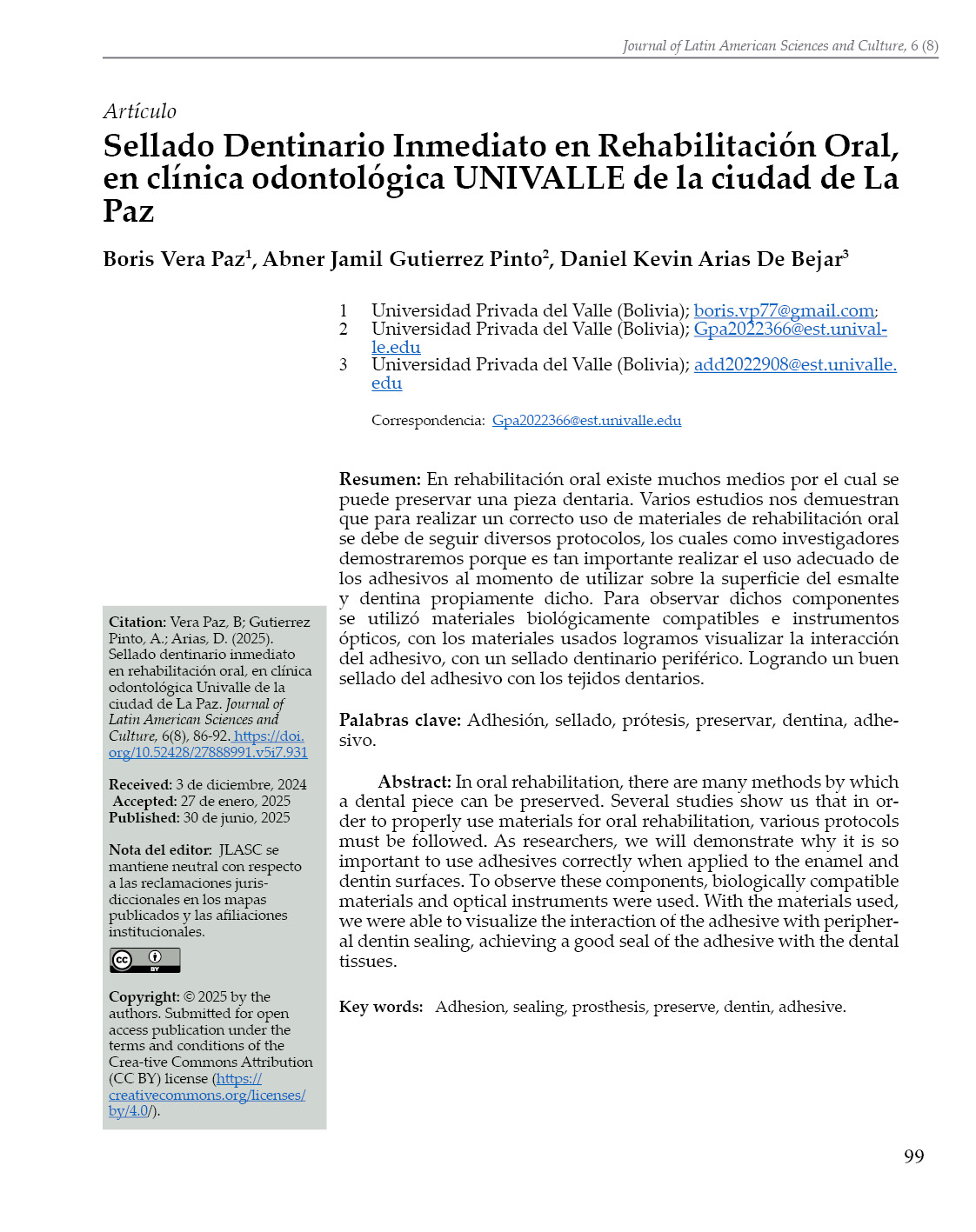
In oral rehabilitation, there are many methods by which a dental piece can be preserved. Several studies show us that in order to properly use materials for oral rehabilitation, various protocols must be followed. As researchers, we will demonstrate why it is so important to use adhesives correctly when applied to the enamel and dentin surfaces. To observe these components, biologically compatible materials and optical instruments were used. With the materials used, we were able to visualize the interaction of the adhesive with peripheral dentin sealing, achieving a good seal of the adhesive with the dental tissues
Downloads
References
Magne P, Douglas WH. Racionalización de la odontología restauradora estética basada en la biomimética.J Esthet Dent. 1999;11:5-15.
https://doi.org/10.1111/j.1708-8240.1999.tb00371.x DOI: https://doi.org/10.1111/j.1708-8240.1999.tb00371.x
PMid:10337285
Paul SJ, Schaerer P. Efecto de los cementos provisionales sobre la fuerza de unión de varios sistemas adhesivos en la dentina.J rehabilitación oral.1997;24:8
Paul SJ, Schaerer P. La técnica de unión dual: un método modificado para mejorar los procedimientos de cementación adhesiva.Int J Periodoncia Dent Restauradora. 1997;17:536-545.
McCabe JF, Rusby S. Adhesión a la dentina: el efecto del curado previo de la resina adhesiva.Hno. Dent J.1994;176:333-336.Revista Latinoamericana de Ciencias y Cultura
Downloads
Published
Issue
Section
License
Copyright (c) 2025 Boris Vera Paz , Abner Jamil Gutierrez Pinto, Daniel Kevin Arias De Bejar

This work is licensed under a Creative Commons Attribution 4.0 International License.
Copyright and Licensing Agreement
Authors who submit and publish their work with this journal agree to the following terms:
-
Copyright and License: Authors retain the copyright of their published work. By submitting the manuscript, they grant the journal the non-exclusive right of first publication. The work is simultaneously licensed under a Creative Commons Attribution 4.0 International (CC BY 4.0) License.
-
Permissions Under CC BY 4.0: This license permits any third party to share, adapt, and redistribute the material for any purpose, including commercial use, provided that appropriate credit is given. Attribution must include citation of the author(s), the article title, the journal name, and the original publication details, along with a link to the CC BY 4.0 license.
-
Author's Rights of Reuse: Authors may enter into separate, additional contractual agreements for the non-exclusive distribution of the journal's published version of the article. This includes depositing it in an institutional repository or including it in a collected volume, provided that clear and proper attribution is given to its initial publication in this journal.
-
Encouragement of Early Sharing: Authors are expressly permitted and encouraged to disseminate their work online prior to and during the submission process. Sharing preprints in community repositories or on personal websites fosters scholarly exchange and can lead to increased early citation and collaboration.
How to Cite