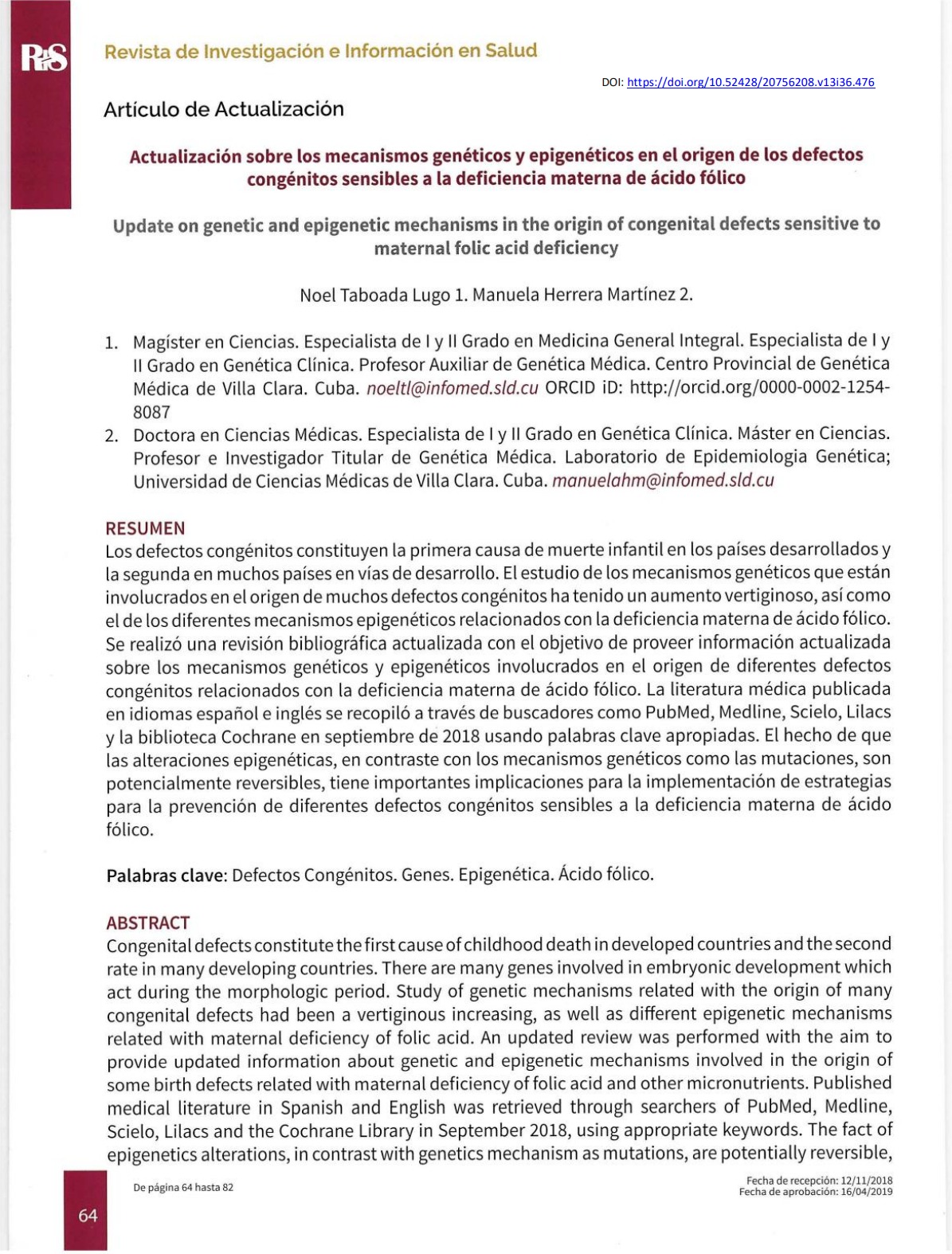
Update on Genetic and Epigenetic Mechanisms in the Origin of Congenital Defects Sensitive to Maternal Folic Acid Deficiency
DOI:
https://doi.org/10.52428/20756208.v13i36.476Keywords:
Birth Defects, Gene, Epigenetic, Folic acidAbstract
Congenital defects constitute the fi rst cause of childhood death in developed countries and the second rate in many developing countries. There are many genes involved in embryonic development which act during the morphologic period. Study of genetic mechanisms related with the origin of many congenital defects had been a vertiginous increasing, as well as different epigenetic mechanisms related with maternal deficiency of folic acid. An updated review was performed with the aim to provide updated information about genetic and epigenetic mechanisms involved in the origin of some birth defects related with maternal deficiency of folic acid and other micronutrients. Published medical literature in Spanish and English was retrieved through searchers of PubMed, Medline, Scielo, Lilacs and the Cochrane Library in September 2018, using appropriate keywords. The fact of epigenetics alterations, in contrast with genetics mechanism as mutations, are potentially reversible, has important implications for implementation of strategies to prevent different birth defects sensitized to the maternal deficiency of folic acid. Keywords: Birth defects. Gene. Epigenetic. Folic acid.
Downloads
References
l. OMS. Anomalías congénitas. 2015 [internet]. [citado 23 Sept 2018] URL disponible en: http://www.who.int/mediacentre/factsheets/fs370/es/
2. PORRAS HGL, LEÓN COM, MOLANO HJ, QUINCENO SL, PACHAJOA H, MONTOYA JJ. Prevalencia de defectos congénitos en Risaralda, 2010-2013. Biomédica [internet]. 2016 36:556-63. [citado 23Sept 2018] URL disponible en: http://dx.doi.org/l0.7705/biomedica.v36i4.277l
3. KHOKHA MK, MITCHELL LE, WALUNGFORD J. An opportunity to address the genetic causes of birth defects. Ped Res 2017; [internet]. 81(2):282-285.[citado 23 Sept 2018]URL disponible en: https://www.nature.com/artic1es/pr2016229.pdf https://doi.org/10.1038/pr.2016.229
4. LANTIGUA CA. Introducción a la Genética Médica. La Habana: Editorial Ciencias Médicas; 2da Ed. 2011.p.401
5. GHE cause categories and ICD-10 codes. In: WHO methods and data sources far country level causes of death 2000-2015. 2017; [internet]. [citado 23 Sept 2018]URL disponible en: http://www.who.int/gho/mortality_burden_disease/en/index.html
6. TABOADA LUGO N. Papel del ácido fálico, zinc y cobre en la prevención primaria de los defectos congénitos. Rev cubana Med Gen lnteg [internet]. 2016; 35 (4). [citado 23 Sept2018]URL disponible en: http://www.revmgi.sld.cu/index.php/mgi/article/view/167
7. JUSTO SO, FERREIRO RA, LLAMOS PA, RODRÍGUEZlY, RIZO LO, YASELL RM, ET AL. Comportamiento clínico epidemiológico de los defectos congénitos en La Habana. Rev Cubana Ped [internet]. 2016; 88(1):34-42 [citado 23 Sept 2018] URL disponible en: http://scielo.sld.cu/pdf/ped/v88nl/ped05116.pdf
8. CRUZ QFP, BENÍTEZ CY, MARCHECO TB. Comportamiento clinico epidemiológico de las anomalías congénitas mayores más frecuentes en Cuba 2010-2016. [Internet] 2017[citado 23 Sept 2018] URL disponible en: http://www.geneticacomunitaria20l7.sld.cu/index.php/gencom/2017/paper/view/426/0
9. BANDYOPADHYAY NEOGI S, SINGH S, RAJ PALLEPOGULA D, PANT H, REDDY KOLLI S, BHARTI P, ET AL. Risk factors far orofacial clefts in India: A case-control study Birth Def Res [internet]. 2017; 109: 1284-1291. [citado 23 Sept 2018] URL disponible en: https://onlinelibrary.wiley.com/doi/pdf/10.1002/bd r2.1073 https://doi.org/10.1002/bdr2.1073
10. SAUNAS TVM, SALINAS TRA, CERDA FRM, MARTÍNEZ VLE. Prevalence, mortality, and spatial distribution of gastroschisis in Mexico. J Pediatr Adolesc Gyneco! [internet]. 2018; [citado 23 Sept 2018] URL disponible en: https://www.ncbi.nlm.nih.gov/pubmed/29317257
11. MARTÍNEZ LG, BLANCO PME, RODRÍGUEZ AY, ENRÍQUEZ DL, MARRERO DI. De la embriogénesis a la prevención de cardiopatías congénitas, defectos del tubo neura! y de pared abdominal. Rev Med Elect [internet]. 2016; 38(2). [citado 23 Sept 2018]URL disponible en: http://scielo.sld.cu/pdf/rme/v38n2/rme 120216.pdf
12. FENG Y, WANG S, CHAEN R, TONG X, WU Z, MO X. Maternal folie acid supplementation and the risk of congenital heart defects in offspring: A meta-analysis of epidemiological observational studies. Sci Rep (Internet]. 2015;5, 8506; [citado 23 Sept 2018] URL disponible en: https://www.nature.com/articles/srep08506.pdf https://doi.org/10.1038/srep08506
13. TABOADA LN, HERRERA MM. Mecanismos epi genéticos y vía de señalización Notch en el origen de diferentes defectos congénitos. Rev Medicentro Elec [internet]. 2018; 22(3) [citado 23 Sept 2018] URL disponible en: http://www.medicentro.sld.cu/index.php/medicentro/article/view/2645/2212
14. LIAD YP, ZHANG D, ZHOU W, MENG FM, BAO MS, XIANG P, LIU CQ. Combined folate gene MTHFD and TC po!ymorphisms as maternal risk factors far Down syndrome in China. Genet Mol Res [internet]. 2014; 13(1):1764-73. [citado 23 Sept 2018] URL disponible en: https://www.geneticsmr.com/sites/defauIt/fiIes/artieles/year2O14/vo113-1/pdf/gmr2725.pdf https://doi.org/10.4238/2014.March.17.4
15. MARTÍNEZ GARCÍA RM, JIMÉNEZ ORTEGA Al, NAVIA LOMBÁN B. Suplementos en gestación: últimas recomendaciones. Nutr Hosp [internet]. 2016; 33 {Supl. 4): 3-7. [citado 23 Sept 2018] URL dispon ib le en: http://scielo.isciii.es/pdf/n h/v33s4/0l_origina l.pdf
16. YANG W, CARMICHAELSL, SHAW GM. Folie acid fortification and prevalences of Neural Tube Defects, Orofacia! Clefts, and Gastroschisis in California, 1989 to 2010. [internet]. 2016;106, 12: 1032- 1041. [citado 23 Sept 2018] URL disponible en: https://onlinelibrary.wiley.com/doi/pdf/10.1002/bdra.23514 https://doi.org/10.1002/bdra.23514
17. NICHOLAS DE. Neural Tube Defects. An Rev Neurosc [internet]. 2014; 37: 221-242. [citado 23 Sept 2018]URL disponible en: https://www.annualreviews.org/doi/pdf/10.1146/annurevneuro-062012-170354 https://doi.org/10.1146/annurev-neuro-062012-170354
18. TABOADA LUGO N, HERRERA MART[NEZ M, HERNÁNDEZ ALAGORA AE, NOCHE GONZÁLEZ G, NOA MACHADO MD. Conglomerados espacio-temporales de defectos del tubo neural y niveles maternos de alfafetoproteína en Villa Clara (2011-2015). Rev cubana Obst Ginecol [internet]. 2016; 42(4). [citado 23 Sept 2018]URL disponible en: http://revginecobstetricia.sld.cu/index.php/gin/article/view/110
19. ARTH A, KANCHERLA V, PACHON H, ZIMMERMAN S, JHONSON Q, OAKLEY GP. A 2015 global update on folie acid-preventable spina bífida and anencephaly. Birth Defects Research (Part A) [internet]. 2016; 106:520-529 [citado 23 Sept 2018] URL disponible en: https://onlinelibrary.wiley.com/doi/pdf/10.1002/bd ra.23529 https://doi.org/10.1002/bdra.23529
20. ZAGANJOR 1, SEKKARIE A, TSANG BL, WILLIAMS J, RAZZAGHI H, MU LINAR E J, SNIEZEK JE, CAN NON MJ, ROSENTHAL J. Describing the prevalence of Neural Tube Defects worldwide: A systematic literature review. PloS one [internet]. 2016; 11(4 [citado 23 Sept 2018] URL disponible en: https://www.ncbi.nlm.nih.gov/pubmed/27064786 https://doi.org/10.1371/journal.pone.0151586
21. BA G, JUN WQ, UNG CY, HONG HY, TING GT. Prevalence and time trends of spina bifida in fourteen cities located in the Liaoning province of northeast China, 2006-2015. Oncotarget [internet]. 2017; 8(12): 18943-18948. [citado 23 Sept 2018] URL disponible en: https://www.ncbi.nlm.nih.gov/pmc/articles/PMC5386660/ https://doi.org/10.18632/oncotarget.14848
22. KHOSHNOOD B, HERMIEN DE WALLE ML, ARRIOLA L, ADDOR MC, BARISIC 1, BERES J, ET AL. Longterm trends in prevalence of neural tube defects in Europe: population based study. BMJ [internet]. 2015; 351:1-6 [citado 23 Sept 2018] URL disponible en: https://www.bmj.com/content/bmj/351/bmj. h5949.full.pdf https://doi.org/10.1136/bmj.h5949
23. MARTÍN-SU BEROJ 1,51 EBERR. Epigenéticayepigenóm ica. BolCient lnf.Acad mexicana Ped. [internet]. 2016; 1:261-277. [citado 23 Sept 2018] URL disponible en: www.academiamexicanadepediatria.com
24. LEUNG KY, PAi YJ, CHEN Q, SANTOS C, CALVANI E, SUDIWALA S, ET AL. Partitioning of one-carbon units in folate and methionine metabolism is essential for neural tube closure. Cell Reports [internet]. 2017; 21: 1795-1808. [citado 23 Sept 2018] URL disponible en: https://doi.org/10.1016/j.celrep.2017 .10.072 https://doi.org/10.1016/j.celrep.2017.10.072
25. MORALES MA, MÉNDEZ K, SOLÍS E, BORJAS BL, BRACHO A, HERNÁNDEZ ML, ET AL. C677T polymorphism of the methylentetrahydrofolate reductase gene in mothers of children affected with neural tube defects. tnvest Clin [internet]. 2015; 56(3):284-95. [citado 26 Feb 2018] URL disponible en: https://www.ncbi.nlm.nih.gov/pubmed/26710543
26. PANGILINAN F, MOLLOYAM, MILLSJL, TROENDLEJF, MCDERMOTT AP, SIGNORE C, ETAL. Evaluation of common genetic variants in 82 candidate genes as risk factors for neural tube defects. BMC Medica[ Genetics [en línea] 2012; 13:62. [citado 23 Sept 2018] URL disponible en: http://www.biomedcentral.com/1471-2350/13/62 https://doi.org/10.1186/1471-2350-13-62
Downloads
Published
Issue
Section
License
Copyright (c) 2019 Noel Taboada Lugo y Manuela Herrera Martínez

This work is licensed under a Creative Commons Attribution 4.0 International License.
Authors who publish with this journal agree to the following terms:
- Authors retain copyright and grant the journal right of first publication with the work simultaneously licensed under a Creative Commons Attribution License 4.0 that allows others to share the work with an acknowledgement of the work's authorship and initial publication in this journal.
- Authors are able to enter into separate, additional contractual arrangements for the non-exclusive distribution of the journal's published version of the work (e.g., post it to an institutional repository or publish it in a book), with an acknowledgement of its initial publication in this journal.
- Authors are permitted and encouraged to post their work online (e.g., in institutional repositories or on their website) prior to and during the submission process, as it can lead to productive exchanges, as well as earlier and greater citation of published work.
How to Cite