
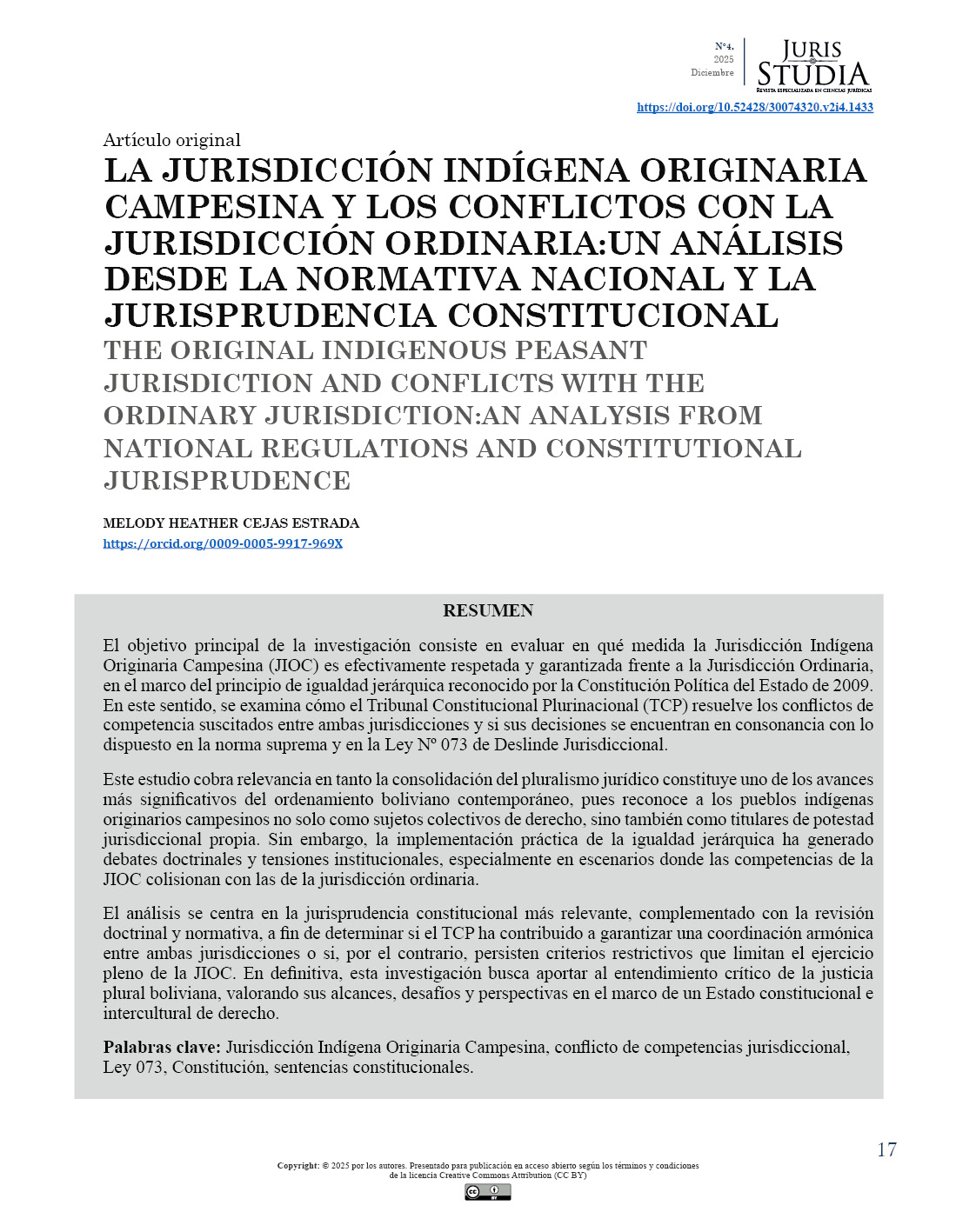
The THE ORIGINAL INDIGENOUS PEASANT JURISDICTION AND CONFLICTS WITH THE ORDINARY JURISDICTION
AN ANALYSIS FROM NATIONAL REGULATIONS AND CONSTITUTIONAL JURISPRUDENCE.
DOI:
https://doi.org/10.52428/30074320.v2i4.1433Keywords:
Indigenous Originary Peasant Jurisdiction, conflict of jurisdictional powers, law 073, constitution, constitutional rulingsAbstract
The main objective of this research is to evaluate the extent to which the Indigenous Originary Peasant Jurisdiction (JIOC) is effectively respected and guaranteed in relation to the Ordinary Jurisdiction, within the framework of the principle of hierarchical equality enshrined in the 2009 Political Constitution of the State. In this regard, the analysis examines how the Plurinational Constitutional Court (TCP) resolves conflicts of jurisdiction arising between both systems and whether its decisions are consistent with the provisions of the Constitution and Law No. 073 on Jurisdictional Demarcation.This study is relevant insofar as the consolidation of legal pluralism represents one of the most significant advances of the contemporary Bolivian legal order, as it recognizes Indigenous Originary Peasant peoples not only as collective subjects of rights but also as holders of their own jurisdictional authority. However, the practical implementation of hierarchical equality has generated doctrinal debates and institutional tensions, particularly in scenarios where the competences of the JIOC overlap or collide with those of the ordinary jurisdiction.The research focuses on the most relevant constitutional case law, complemented by doctrinal and normative review, in order to determine whether the TCP has contributed to ensuring a harmonious coordination between both jurisdictions or whether restrictive criteria continue to limit the full exercise of the JIOC. Ultimately, this investigation seeks to contribute to a critical understanding of Bolivian plural justice, assessing its scope, challenges, and prospects within the framework of a constitutional and intercultural rule of law.
References
Calderón Medrano, C. A. (2020). La importancia de la jurisprudencia y el precedente en el sistema de justicia boliviano. Sucre, Bolivia: Imprenta Gráfica Chucamanis.
Estado Plurinacional de Bolivia. (2009). Constitución política del Estado Plurinacional de Bolivia. Bolivia.
Estado Plurinacional de Bolivia. (2010). Ley N°073 "De deslinde jurisdiccional". Bolivia.
Estado Plurinacional de Bolivia. (5 de julio de 2012). Código procesal constitucional. La Paz, Bolivia: Gaceta oficial del Estado.
Sampieri, R. H., Collado, C. F., Lucio, P. B., Valencia, S. M., & Torres, C. P. M. (2014). Metodología de la investigación.
Tribunal Constitucional Plurinacional. (1 de diciembre de 2014). Sentencia constitucional plurinacional 1990/2014. Sucre, Chuquisaca, Bolivia.
Tribunal Constitucional Plurinacional. (4 de enero de 2013). Sentencia constitucional plurinacional 0026/2013. Sucre, Bolivia.
Tribunal Constitucional Plurinacional. (6 de febrero de 2019). Sentencia constitucional plurinacional 0009/2019 del 6 de febrero. Sucre, Bolivia.
Tribunal Constitucional Plurinacional de Bolivia. (24 de junio de 2016). Sentencia constitucional plurinacional 0060/2016. Sucre, Chuquisaca, Bolivia.
Tribunal Constitucional Plurinacional de Bolivia. (5 de diciembre de 2023). Sentencia constitucional plurinacional 0139/2023. Sucre, Chuquisaca, Bolivia.
República de Bolivia. (12 de agosto de 1994). Constitución política del Estado 1994. Bolivia.
Downloads
Published
How to Cite
Issue
Section
License
Copyright (c) 2025 Juan Carlos Ivan Cejas Estrada

This work is licensed under a Creative Commons Attribution 4.0 International License.
Authors who publish with this journal agree to the following terms:
- Authors retain copyright and grant the journal right of first publication with the work simultaneously licensed under a Creative Commons Attribution License 4.0 that allows others to share the work with an acknowledgement of the work's authorship and initial publication in this journal.
- Authors are able to enter into separate, additional contractual arrangements for the non-exclusive distribution of the journal's published version of the work (e.g., post it to an institutional repository or publish it in a book), with an acknowledgement of its initial publication in this journal.
- Authors are permitted and encouraged to post their work online (e.g., in institutional repositories or on their website) prior to and during the submission process, as it can lead to productive exchanges, as well as earlier and greater citation of published work.