Validated Antimicrobial Spectrum of Antiseptics, Disinfectants and Enzymatic Detergents for Hospital Use at Laboratorio Clínico Central
DOI:
https://doi.org/10.52428/20756208.v13i36.471Keywords:
Antiseptics, Disinfectants, Enzymatic detergents, Antimicrobial actionAbstract
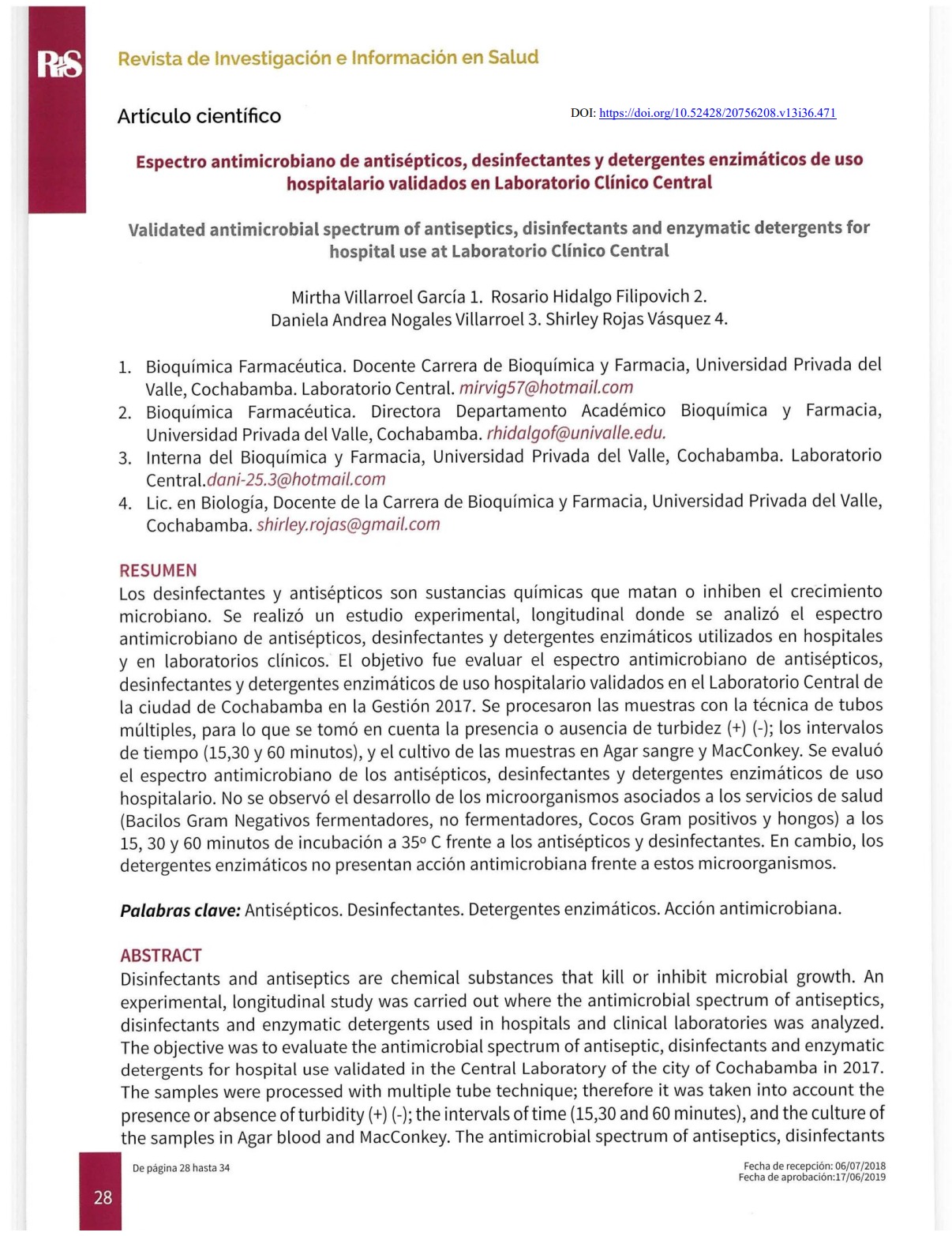
Disinfectants and antiseptics are chemical substances that kill or inhibit microbial growth. An experimental, longitudinal study was carried out where the antimicrobial spectrum of antiseptics, disinfectants and enzymatic detergents used in hospitals and clinical laboratories was analyzed. The objective was to evaluate the antimicrobial spectrum of antiseptic, disinfectants and enzymatic detergents for hospital use validated in the Central Laboratory of the city of Cochabamba in 2017. The samples were processed with multiple tube technique; therefore it was taken into account the presence or absence ofturbidity (+) (-); the intervals oftime (15,30 and 60 minutes), and the culture of the samples in Agar blood and MacConkey. The antimicrobial spectrum of antiseptics, disinfectants and enzymatic detergents for hospital use was evaluated. The development of microorganisms associated with health services was not observed (Gram-negative bacilli fermenters, non-fermenters, Gram-positive cocci and fungi) at 15, 30 and 60 minutes of incubation at 35 0 C compared to antiseptics and disinfectants. On the Other hand, enzymatic detergents do not have antimicrobial action against these microorganisms.
Downloads
References
l. Conceptos básicos de enzimas. Detergentes enzimáticos. 28/09/18. Sitio web: https://conceptosbasicosdeenzimas.wikispaces.com/Detergentes+enzimaticos
2. MEDINA L, VALENCIA L. (2008). Evaluación de la eficacia de un desinfectante de alto nivel, a base de peróxido de hidrógeno, empleado en la esterilización de dispositivos e instrumentos hospitalarios. (Tesis de pregrado). Pontificia Universidad Javeriana. Bogotá - Colombia.
3. DIOMEDI A, CHACÓN E, DELPIANO L, HERVÉ B, JEMENAO M, MEDEL M, QUINTANILLA M, RIEDEL G, TINOCO J & CIFUENTES M. (2017). Antisépticos y desinfectantes: apuntando al uso racional. Recomendaciones del Comité Consultivo de Infecciones Asociadas a la Atención de Salud, Sociedad Chilena de lnfectología. 19/09/18, de Revista chilena de infectologia Sitio web: http://www.revista.sochinf.ci/pdf-rev2-20l7/artll.pdf https://doi.org/10.4067/S0716-10182017000200010
4. L. SÁNCHEZ-SALDAÑA, E. SÁENZ-ANDUAGA. (2005). Antisépticos y desinfectantes. Dermatología peruana, Volumen 15, 82-100.
5. MARTINEZ M. (2013). Guía de antisépticos y desinfectantes. 01/10/18, de Instituto nacional de gestión sanitaria. Sitio web: http://www.ingesa.mscbs.gob.es/estadEstudios/documPublica/internet/pdf/G uia_Antisepticos_desinfectantes.pdf
6. AYESTARAN A. (2012). Clorhexidina 2% en la desinfección del campo quirúrgico. 28/09/18, de Sociedad española de farmacia hospitalaria Sitio web: http://gruposdetrabajo.sefh.es/genesis/genesis/Documents/Clorhexidina_alcohol_desinf_campo_quirurgico_HBA_03_2012.pdf
Downloads
Published
Issue
Section
License
Copyright (c) 2019 Mirtha Villarroel García, Rosario Hidalgo Filipovich, Daniela Andrea Nogales Villarroel y Shirley Rojas Vásquez

This work is licensed under a Creative Commons Attribution 4.0 International License.
Authors who publish with this journal agree to the following terms:
- Authors retain copyright and grant the journal right of first publication with the work simultaneously licensed under a Creative Commons Attribution License 4.0 that allows others to share the work with an acknowledgement of the work's authorship and initial publication in this journal.
- Authors are able to enter into separate, additional contractual arrangements for the non-exclusive distribution of the journal's published version of the work (e.g., post it to an institutional repository or publish it in a book), with an acknowledgement of its initial publication in this journal.
- Authors are permitted and encouraged to post their work online (e.g., in institutional repositories or on their website) prior to and during the submission process, as it can lead to productive exchanges, as well as earlier and greater citation of published work.
How to Cite