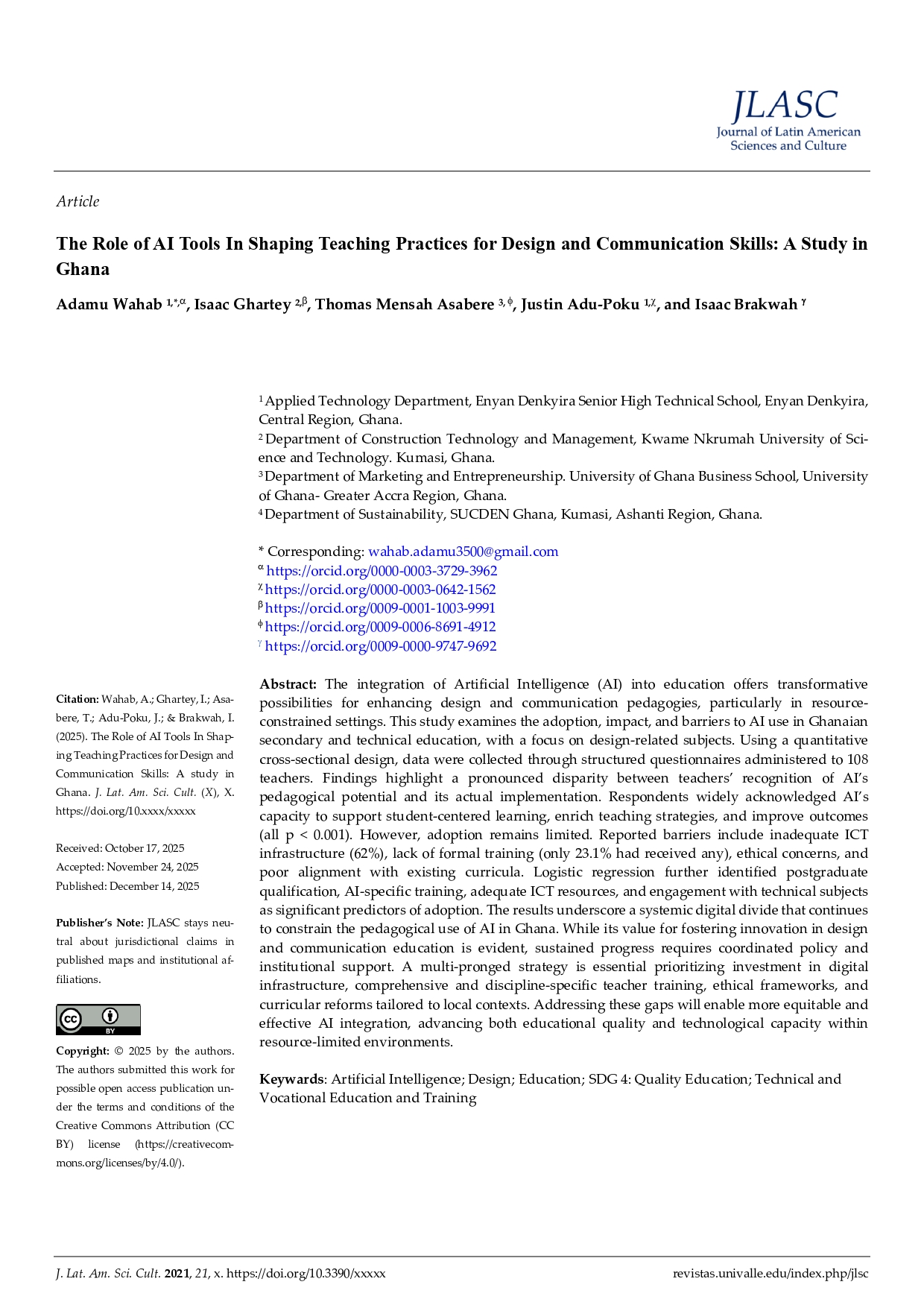
The Role of AI Tools In Shaping Teaching Practices for Design and Communication Skills: A Study in Ghana
DOI:
https://doi.org/10.52428/27888991.v7i11.1470Keywords:
Artificial Intelligence, Design, Education, SDG 4: Quality Education, Technical and Vocational Education and TrainingAbstract
The integration of Artificial Intelligence (AI) into education offers transformative possibilities for enhancing design and communication pedagogies, particularly in resource-constrained settings. This study examines the adoption, impact, and barriers to AI use in Ghanaian secondary and technical education, with a focus on design-related subjects. Using a quantitative cross-sectional design, data were collected through structured questionnaires administered to 108 teachers. Findings highlight a pronounced disparity between teachers’ recognition of AI’s pedagogical potential and its actual implementation. Respondents widely acknowledged AI’s capacity to support student-centered learning, enrich teaching strategies, and improve outcomes (all p < 0.001). However, adoption remains limited. Reported barriers include inadequate ICT infrastructure (62%), lack of formal training (only 23.1% had received any), ethical concerns, and poor alignment with existing curricula. Logistic regression further identified postgraduate qualification, AI-specific training, adequate ICT resources, and engagement with technical subjects as significant predictors of adoption. The results underscore a systemic digital divide that continues to constrain the pedagogical use of AI in Ghana. While its value for fostering innovation in design and communication education is evident, sustained progress requires coordinated policy and institutional support. A multi-pronged strategy is essential prioritizing investment in digital infrastructure, comprehensive and discipline-specific teacher training, ethical frameworks, and curricular reforms tailored to local contexts. Addressing these gaps will enable more equitable and effective AI integration, advancing both educational quality and technological capacity within resource-limited environments.
Downloads
References
Adobea, A., Nyantakyi, G. K., Fosu, P., & Tuffour, D. A. (2024). Technological Tools and their Impact on Ghanaian Language (Twi) Lesson Delivery: The Role of the College Tutor. International Journal of Research and Innovation in Social Science, VIII(I), 2248–2258. https://doi.org/10.47772/ijriss.2024.801164
Al-Zahrani, A. M., & Alasmari, T. M. (2024). Exploring the impact of artificial intelligence on higher education: The dynamics of ethical, social, and educational implications. Humanities and Social Sciences Communications, 11(1). https://doi.org/10.1057/s41599-024-03432-4
Arkorful, V., Arthur, F., Boateng, E., Ofosu-Koranteng, M., Salifu, I., Attom, E. R., Tetteh, S. A., Quayson, E., Asare-Bediako, S., & Nortey, S. A. (2025). Exploring artificial intelligence literacy among basic school teachers in Ghana. Discover Education, 4(1). https://doi.org/10.1007/s44217-025-00630-3
Bircan, M. A., Şeref, İ., & Nacaroğlu, O. (2025). The effect of STEM themed story writing training with artificial intelligence tools on the digital literacy and 21 st century skills of preservice teachers. Education and Information Technologies. https://doi.org/10.1007/s10639-025-13625-2
Borger, J. G., Ng, A. P., Anderton, H., Ashdown, G. W., Auld, M., Blewitt, M. E., Brown, D. V., Call, M. J., Collins, P., Freytag, S., Harrison, L. C., Hesping, E., Hoysted, J., Johnston, A., McInneny, A., Tang, P., Whitehead, L., Jex, A., & Naik, S. H. (2023). Artificial intelligence takes center stage: exploring the capabilities and implications of ChatGPT and other AI‐assisted technologies in scientific research and education. Immunology and Cell Biology, 101(10), 923–935. https://doi.org/10.1111/imcb.12689
Dwivedi, Y. K., Hughes, L., Ismagilova, E., Aarts, G., Coombs, C., Crick, T., Duan, Y., Dwivedi, R., Edwards, J., Eirug, A., Galanos, V., Ilavarasan, P. V., Janssen, M., Jones, P., Kar, A. K., Kizgin, H., Kronemann, B., Lal, B., Lucini, B., Williams, M. D. (2019). Artificial Intelligence (AI): Multidisciplinary perspectives on emerging challenges, opportunities, and agenda for research, practice and policy. International Journal of Information Management, 57, 101994. https://doi.org/10.1016/j.ijinfomgt.2019.08.002
Dwivedi, Y. K., Kshetri, N., Hughes, L., Slade, E. L., Jeyaraj, A., Kar, A. K., Baabdullah, A. M., Koohang, A., Raghavan, V., Ahuja, M., Albanna, H., Albashrawi, M. A., Al-Busaidi, A. S., Balakrishnan, J., Barlette, Y., Basu, S., Bose, I., Brooks, L., Buhalis, D., Wright, R. (2023). Opinion Paper: “So what if ChatGPT wrote it?” Multidisciplinary perspectives on opportunities, challenges and implications of generative conversational AI for research, practice and policy. International Journal of Information Management, 71, 102642. https://doi.org/10.1016/j.ijinfomgt.2023.102642
Gyamfi, N. K., Dayie, R., & Asiedu, E. K. (2022). Application of Artificial intelligence techniques in educational delivery; Ghana perspective. Webology, 19(1), 480–492. https://doi.org/10.14704/web/v19i1/web19034
Kruk, M., & Kałużna, A. (2024). Investigating the role of AI tools in enhancing translation skills, emotional experiences, and motivation in L2 learning. European Journal of Education. https://doi.org/10.1111/ejed.12859
Labadze, L., Grigolia, M., & Machaidze, L. (2023). Role of AI chatbots in education: systematic literature review. International Journal of Educational Technology in Higher Education, 20(1). https://doi.org/10.1186/s41239-023-00426-1
Liekum, L. B. (2025). Harnessing Artificial intelligence in teaching Ghanaian Colleges of Education in the 21st century: Enhancing quality teaching, student research, and learning abilities. American Journal of Multidisciplinary Research and Innovation, 4(3), 191–204. https://doi.org/10.54536/ajmri.v4i3.4457
Mohammed, A. S. (2023). Examining the Implementation of Artificial Intelligence in Early Childhood Education Settings in Ghana: Educators’ Attitudes and Perceptions towards Its Long-Term Viability. American Journal of Education and Technology, 2(4), 36–49. https://doi.org/10.54536/ajet.v2i4.2201
Osondu, J., Francois, E. J., & Strycker, J. (2024). Artificial intelligence as a policy response to teaching and learning issues in education in Ghana. Journal of Global Education and Research, 8(3), 236–253. https://doi.org/10.5038/2577-509x.8.3.1361
Segbenya, M., Bervell, B., Frimpong-Manso, E., Otoo, I. C., Andzie, T. A., & Achina, S. (2023). Artificial intelligence in higher education: Modelling the antecedents of artificial intelligence usage and effects on 21st century employability skills among postgraduate students in Ghana. Computers and Education Artificial Intelligence, 5, 100188. https://doi.org/10.1016/j.caeai.2023.100188
Shum, S. J. B., & Luckin, R. (2019). Learning analytics and AI: Politics, pedagogy and practices. British Journal of Educational Technology, 50(6), 2785–2793. https://doi.org/10.1111/bjet.12880
Published
How to Cite
Issue
Section
License
Copyright (c) 2025 Adamu Wahab, Ghartey Isaac, Thomas Mensah Asabere , Justin Adu-Poku, Isaac Brakwah

This work is licensed under a Creative Commons Attribution 4.0 International License.
Authors who publish in this journal accept the following conditions: The authors retain the copyright and assign to the journal the right of the first publication, with the work registered with the Creative Commons 4.0 attribution license, which allows third parties to use what is published as long as they mention the authorship of the work and the first publication in this journal. Authors may make other independent and additional contractual agreements for the non-exclusive distribution of the version of the article published in this journal (eg, include it in an institutional repository or publish it in a book) provided that they clearly indicate that the work it was first published in this magazine. Authors are allowed and encouraged to share their work online (for example: in institutional repositories or personal web pages) before and during the manuscript submission process, as it can lead to productive exchanges, more and more quick citation of published work.