
LEGAL PLURALISM, HUMAN RIGHTS, AND DEMOCRACY IN TENSION: A CRITICAL LOOK AT THE EXERCISE OF POWER IN SOME IOC COMMUNITIES IN BOLIVIA
A CRITICAL LOOK AT THE EXERCISE OF POWER IN SOME IOC COMMUNITIES IN BOLIVIA
DOI:
https://doi.org/10.52428/30074320.v2i4.1442Keywords:
Pluralismo jurídico, Derechos humanos, Jurisdicción indígena, Bloque de constitucionalidad, Coordinación interjurisdiccional, DemocraciaAbstract
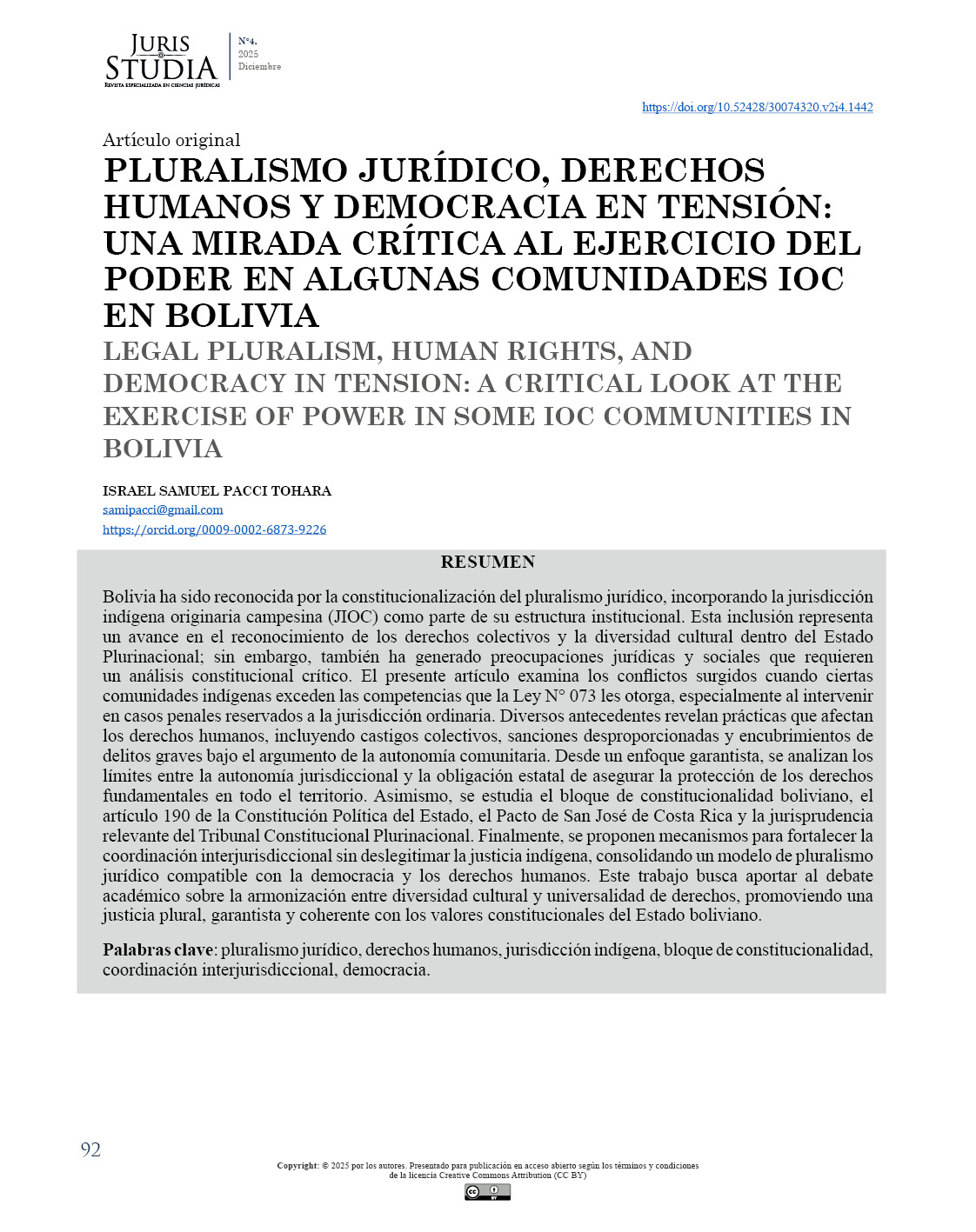
Bolivia has been recognized for the constitutionalization of legal pluralism by incorporating the Indigenous Native Peasant Jurisdiction (JIOC) into its institutional framework. This inclusion represents significant progress in recognizing collective rights and cultural diversity within the Plurinational State; however, it has also raised legal and social concerns requiring critical constitutional analysis. This article examines conflicts arising when certain Indigenous communities exceed the competences granted by Law No. 073, particularly by intervening in criminal matters reserved for the ordinary jurisdiction. Several precedents reveal practices that violate human rights, including collective punishments, disproportionate sanctions, and the concealment of serious crimes under the argument of community autonomy. From a rights-based constitutional perspective, this study analyzes the limits between jurisdictional autonomy and the State’s obligation to ensure the protection of human rights throughout its territory. It also examines Bolivia’s constitutional block, Article 190 of the Constitution, the American Convention on Human Rights, and relevant jurisprudence of the Plurinational Constitutional Tribunal. Finally, the article proposes mechanisms to strengthen interjurisdictional coordination without delegitimizing Indigenous justice, consolidating a model of legal pluralism compatible with democracy and human rights. This work seeks to contribute to academic debate on harmonizing cultural diversity with the universality of rights, promoting a plural, rights-based, and constitutionally coherent justice system within the Bolivian State.
References
Interdialogando. Hacia la construcción plural del derecho desde la cosmovisión de la Nación Yampara. (2015, julio 21). Oficina de la Fundación en Bolivia. https://www.kas.de/es/web/bolivien/laenderberichte/detail/-/content/interdialogando.-zur-pluralen-rechtskonstruktion-aus-der-weltanschauung-der-nation-der-yampara
Caso Rosendo Cantú y otra vs. México | Comisión Nacional de los Derechos Humanos-México. (s. f.). Recuperado 10 de octubre de 2025, de https://www.cndh.org.mx/documento/caso-rosendo-cantu-y-otra-vs-mexico
Chile, B. del C. N. de. (2014, noviembre 27). D) Biblioteca del Congreso Nacional de Chile [Text]. Biblioteca del Congreso Nacional de Chile. https://www.bcn.cl/portal/leyfacil/recurso/convenio-169-oit
Derechos de los Pueblos Indígenas y Tribales sobre sus Tierras Ancestrales. (s. f.). Recuperado 8 de diciembre de 2025, de https://cidh.org/countryrep/TierrasIndigenas2009/Cap.VI.htm
Justia Bolivia: Nueva Constitución Política del Estado: Ley de Bolivia. (s. f.). Recuperado 10 de octubre de 2025, de https://bolivia.justia.com/nacionales/nueva-constitucion-politica-del-estado/
Ley de Deslinde Jurisdiccional, Ley N° 73 del 29 de diciembre de... (s. f.). Recuperado 10 de octubre de 2025, de https://www.bivica.org/file/view/id/2368
Mayta, R. A. C., & Siqueira, J. do C. A. (2025). Pluralismo jurídico y jurisdicción indígena en Bolivia: Desafíos y conflictos en el Valle de Zongo: Pluralismo jurídico e jurisdição indígena na Bolívia: Desafios e conflitos no Vale de Zongo. Revista da Faculdade de Direito da UFG, 49(1). https://doi.org/10.5216/rfd.v49i1.82107
Medinaceli Rojas, G. (2011). Criterios de interpretación en la nueva Constitución de Bolivia. Voluntad del constituyente vs. Jurisprudencia de la Corte Interamericana de Derechos Humanos (Tema Central). http://repositorio.uasb.edu.ec/handle/10644/3137
Sentencia Constitucional Plurinacional 0150/2016-S1. (s. f.). Recuperado 8 de diciembre de 2025, de https://jurisprudenciaconstitucional.com/resolucion/6747-sentencia-constitucional-plurinacional-0150-2016-s1
Sentencia Constitucional Plurinacional 0303/2018-S3. (s. f.). Recuperado 8 de diciembre de 2025, de https://jurisprudenciaconstitucional.com/resolucion/34674
Sentencia Constitucional Plurinacional 0358/2013. (s. f.). Recuperado 8 de diciembre de 2025, de https://jurisprudenciaconstitucional.com/resolucion/8548-sentencia-constitucional-plurinacional-0358-2013
Sentencia Constitucional Plurinacional 1137/2017-S2 SUCRE, 6 de noviembre de 2017. (s. f.). Recuperado 8 de diciembre de 2025, de https://jurisprudenciaconstitucional.com/resolucion/24577-sentencia-constitucional-plurinacional-1137-2017-s2
Sentencia del TCP legaliza unión libre entre personas del mismo sexo. (2023, marzo 22). Fundación Construir. https://www.fundacionconstruir.org/monitoreo/sentencia-del-tcp-legaliza-union-libre-entre-personas-del-mismo-sexo/
Tribunal Constitucional Plurinacional. (s. f.-a). Recuperado 8 de diciembre de 2025, de https://jurisprudencia.tcpbolivia.bo/Fichas/FichaResultado/19280
Tribunal Constitucional Plurinacional. (s. f.-b). Recuperado 10 de octubre de 2025, de https://jurisprudencia.tcpbolivia.bo/Fichas/Ficha/20633
Downloads
Published
How to Cite
Issue
Section
License
Copyright (c) 2025 Israel Samuel Pacci Tohara

This work is licensed under a Creative Commons Attribution 4.0 International License.
Authors who publish with this journal agree to the following terms:
- Authors retain copyright and grant the journal right of first publication with the work simultaneously licensed under a Creative Commons Attribution License 4.0 that allows others to share the work with an acknowledgement of the work's authorship and initial publication in this journal.
- Authors are able to enter into separate, additional contractual arrangements for the non-exclusive distribution of the journal's published version of the work (e.g., post it to an institutional repository or publish it in a book), with an acknowledgement of its initial publication in this journal.
- Authors are permitted and encouraged to post their work online (e.g., in institutional repositories or on their website) prior to and during the submission process, as it can lead to productive exchanges, as well as earlier and greater citation of published work.