
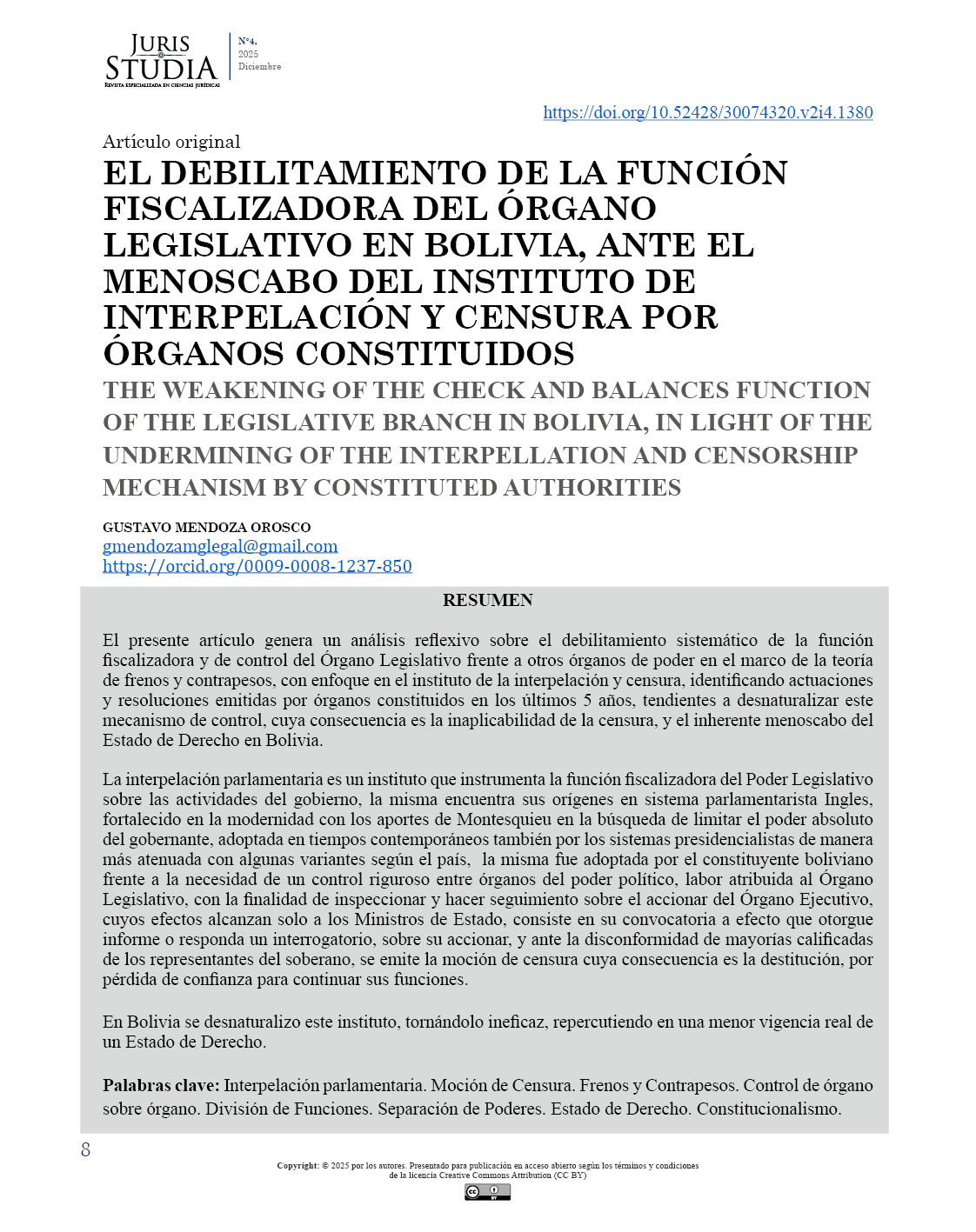
THE WEAKENING OF THE CHECK AND BALANCES FUNCTION OF THE LEGISLATIVE BRANCH IN BOLIVIA, IN LIGHT OF THE UNDERMINING OF THE INTERPELLATION AND CENSORSHIP MECHANISM BY CONSTITUTED AUTHORITIES
DOI:
https://doi.org/10.52428/30074320.v2i4.1380Keywords:
Parliamentary Interpellation. Inter-Institutional Oversight. Division of Functions. Separation of Powers. Rechtsstaat. Constitutionalism.Abstract
This article provides a reflective analysis of the systematic weakening of the oversight and control function of the Legislative Branch in relation to other branches of power within the framework of the theory of checks and balances. It focuses on the institution of parliamentary interpellation and censure, identifying actions and resolutions issued by constituted powers over the past five years that have aimed to undermine this control mechanism. The result of this process is the inapplicability of censure and the inherent weakening of the Rechtsstaat in Bolivia.
Parliamentary interpellation is an institution that enables the Legislative Branch to exercise oversight over government activities. Its origins lie in the British parliamentary system, which was further strengthened in modernity by Montesquieus contributions to limiting the absolute power of rulers. It has also been adopted by presidential systems, albeit in a more attenuated form with variations according to each country. The Bolivian constituent assembly adopted this institution in response to the need for rigorous oversight between the branches of political power, a responsibility entrusted to the Legislative Branch in order to inspect and monitor the actions of the Executive Branch. This mechanism only applies to State Ministers and involves their summons to provide a report or answer questions regarding their conduct. Should a weighted majority of representatives of the sovereign express dissatisfaction, a motion of censure is issued, resulting in the removal of the official due to a loss of confidence to continue in office.
In Bolivia, this institution has been systematically undermined, rendering it ineffective and leading to a diminished real effectiveness of the Rechtsstaat.
References
Agencia de Noticias Fides. (2020). Página web de la Agencia de Noticias Fides. https://www.noticiasfides.com/nacional/politica/anez-vuelve-a-posesionar-a-ministros-murillo-y-cardenas-que-fueron-censurados-por-el-legislativo-406793
Congreso Nacional de Chile. (2018). Página web de la Biblioteca del Congreso Nacional de Chile. https://obtienearchivo.bcn.cl/obtienearchivo?id=repositorio/10221/26819/2/Interpelacion_Parlamentaria._Analisis_desde_diferentes_sistemas_de_gobierno.pdf
Constitución Política del Estado. (2009, 7 de febrero). Bolivia.
Etimologías. (2025). Página web de Etimologías Chile. https://etimologias.dechile.net/?interpelar
Ley 1350. (2020, 16 de septiembre). Ley que regula los efectos de la censura determinada por la Asamblea Legislativa Plurinacional.
Ossorio, M. (2008). Diccionario de ciencias jurídicas, políticas y sociales. Heliasta.
Tribunal Constitucional Plurinacional. (2018). Las Constituciones Políticas de Bolivia. Bolivia.
Tribunal Constitucional Plurinacional. (2023). Sentencia Constitucional Plurinacional No. 0020/2023. https://buscador.tcpbolivia.bo/busqueda-expediente/
Tribunal Constitucional Plurinacional. (2025). Página web oficial del Tribunal Constitucional Plurinacional. https://buscador.tcpbolivia.bo/busqueda-expediente/
Órgano Electoral Plurinacional. (2025). Página web oficial del Órgano Electoral Plurinacional. https://www.oep.org.bo/procesos-electorales-y-consultas/elecciones-generales/
Universidad Católica de Chile. Los orígenes anglosajones del constitucionalismo moderno. https://revistauniversitaria.uc.cl/especial/los-origenes-anglosajones-del-constitucionalismo-moderno/11415/:~:text=Este%20dio%20origen%20a%20la,francesa%20y%20las%20independencias%20latinoamericanas.
Downloads
Published
How to Cite
Issue
Section
License
Copyright (c) 2025 Gustavo Mendoza Orosco

This work is licensed under a Creative Commons Attribution 4.0 International License.
Authors who publish with this journal agree to the following terms:
- Authors retain copyright and grant the journal right of first publication with the work simultaneously licensed under a Creative Commons Attribution License 4.0 that allows others to share the work with an acknowledgement of the work's authorship and initial publication in this journal.
- Authors are able to enter into separate, additional contractual arrangements for the non-exclusive distribution of the journal's published version of the work (e.g., post it to an institutional repository or publish it in a book), with an acknowledgement of its initial publication in this journal.
- Authors are permitted and encouraged to post their work online (e.g., in institutional repositories or on their website) prior to and during the submission process, as it can lead to productive exchanges, as well as earlier and greater citation of published work.