The Knowledge and risk behaviors regarding the human immunodeficiency virus (HIV) and other sexually transmitted infections in the university population
Conocimientos y conductas de riesgo frente al VIH y Otras ITS
DOI:
https://doi.org/10.52428/20756208.v20i49.1440Keywords:
Conocimiento, estudiantes, enfermería, Ciencias de la Salud, Educacion, SaludAbstract
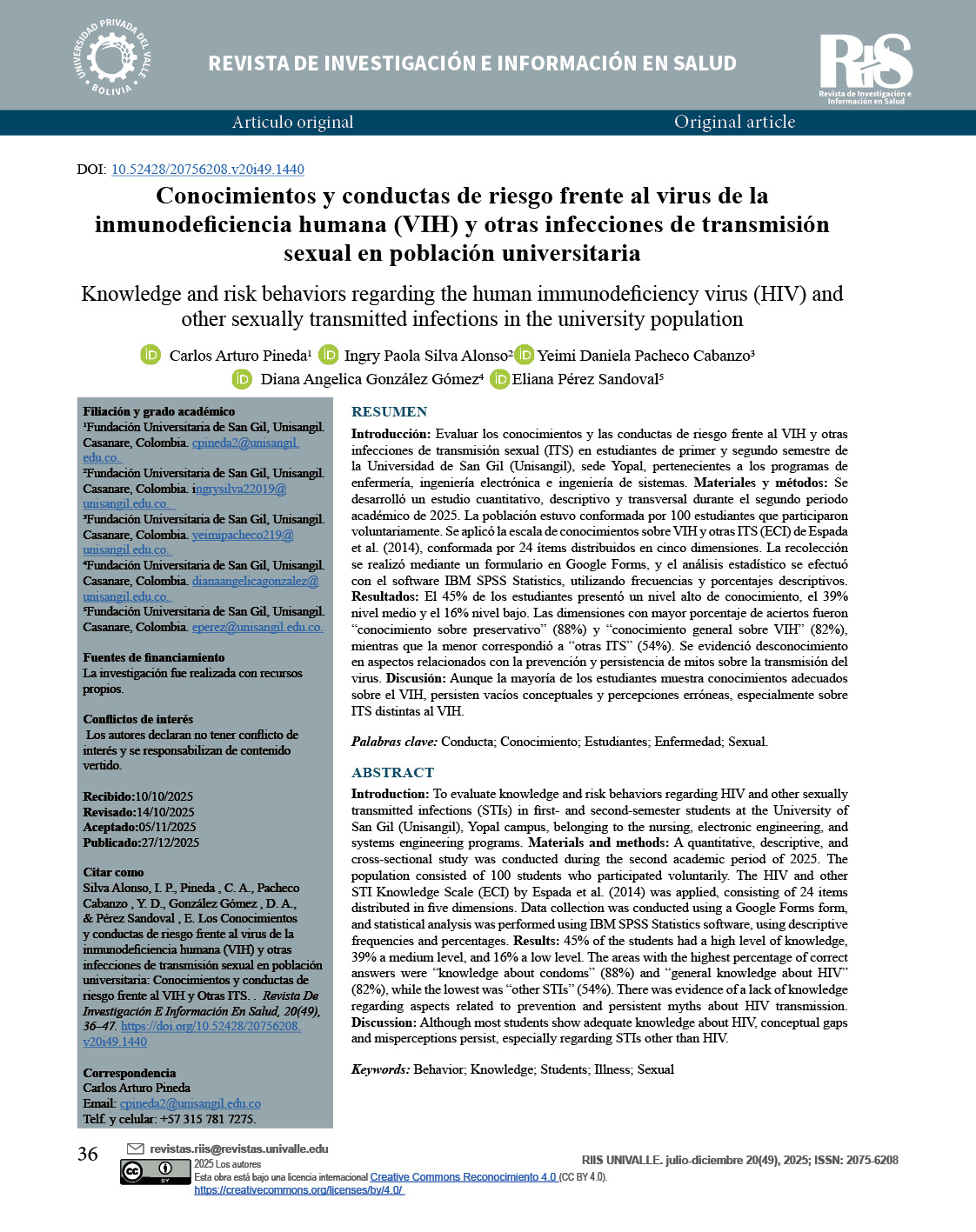
Introduction: To evaluate knowledge and risk behaviors regarding HIV and other sexually transmitted infections (STIs) in first- and second-semester students at the University of San Gil (Unisangil), Yopal campus, belonging to the nursing, electronic engineering, and systems engineering programs. Materials and methods: A quantitative, descriptive, and cross-sectional study was conducted during the second academic period of 2025. The population consisted of 100 students who participated voluntarily. The HIV and other STI Knowledge Scale (ECI) by Espada et al. (2014) was applied, consisting of 24 items distributed in five dimensions. Data collection was conducted using a Google Forms form, and statistical analysis was performed using IBM SPSS Statistics software, using descriptive frequencies and percentages. Results: 45% of the students had a high level of knowledge, 39% a medium level, and 16% a low level. The areas with the highest percentage of correct answers were "knowledge about condoms" (88%) and "general knowledge about HIV" (82%), while the lowest was "other STIs" (54%). There was evidence of a lack of knowledge regarding aspects related to prevention and persistent myths about HIV transmission. Discussion: Although most students show adequate knowledge about HIV, conceptual gaps and misperceptions persist, especially regarding STIs other than HIV.
Downloads
References
1. Organización Mundial de la Salud (OMS). VIH/SIDA: Datos y cifras [Internet]. Ginebra: OMS; 2024 [citado 2025 Oct 6]. Disponible en: https://www.who.int/es/news-room/fact-sheets/detail/hiv-aids
2. HIV.gov. ¿Cómo se transmite el VIH? [Internet]. Actualizado 17 septiembre 2025 [citado 2025 oct 9]. Disponible en: https://www.hiv.gov/hiv-basics/overview/about-hiv-and-aids/how-is-hiv-transmitted
3. Flickr S en. ¿Cómo se transmite el VIH? [Internet]. https://espanol.nichd.nih.gov/. [citado el 9 de octubre de 2025]. Disponible en: https://espanol.nichd.nih.gov/salud/temas/hiv/informacion/contagia
4. ONUSIDA. Hoja informativa — Últimas estadísticas sobre el estado de la epidemia de sida [Internet]. Unaids.org. [citado el 7 de octubre de 2025]. Disponible en: https://www.unaids.org/es/resources/documents/2025/UNAIDS_FactSheet
5. Instituto Nacional de Salud (INS). Informe de evento: VIH/SIDA, Colombia 2023 [Internet]. Bogotá: Subdirección de Vigilancia en Salud Pública; 2023 [citado 2025 Oct 6]. Disponible en: https://www.ins.gov.co DOI: https://doi.org/10.33610/400816ruxhbr
6. Garcia MR, Leslie SW, Wray AA. Sexually transmitted infections. En: StatPearls. Treasure Island (FL): StatPearls Publishing; 2025. [citado el 9 de octubre de 2025]. Disponible en: https://pubmed.ncbi.nlm.nih.gov/32809643/
7. Organización Mundial de la Salud (OMS). Infecciones de transmisión sexual (ITS) [Internet]. Ginebra: OMS; 2024 [citado 2025 oct 9]. Disponible en: https://www.who.int/es/news-room/fact-sheets/detail/sexually-transmitted-infections-(stis)
8. Santana. DBM, editor. boletín epidemiológico semanal. [citado 9 de octubre de 2025]. Disponible en: https://files.sld.cu/ipk/files/2025/08/Bol25w-25.pdf; 2025
9. Ministerio de Salud y Protección Social (Colombia). Otras infecciones de transmisión sexual (ITS) [Internet]. [citado 2025 oct 9]. Disponible en: https://www.minsalud.gov.co/salud/publica/ssr/Paginas/infecciones-transmision-sexual-vih-sida.aspx
10. Espada, Guillén-Riquelme, Morale, Orgilés, Sierra. Conocimientos sobre VIH e ITS: Evaluación [Internet]. Scribd. 2014 [cited 2025 Oct 9]. Available from: https://www.scribd.com/document/426450053/Escala-de-conocimientos
11. Encuesta sobre los conocimientos acerca del VIH [Internet]. Google Docs. [citado 9 de octubre de 2025]. Disponible en: https://docs.google.com/forms/d/1USrYXouQ4A3cnoFvoVKa1JVjnvjICCwN1IaeVWsNAoM/edit?hl=es-419&pli=1
12. García-Mora A, Mendoza-Brizio MA, González-Gutiérrez A, Hernández-González M, Ginnette Ortega-Escamilla P. Conocimientos y prácticas de riesgo ante el VIH/SIDA en adolescentes de la Facultad de Planeación Urbana y Regional de la Universidad Autónoma del Estado de México. Med Investig [Internet]. 2014;2(2):121-7. Disponible en: http://dx.doi.org/10.1016/s2214-3106(15)30008-x DOI: https://doi.org/10.1016/S2214-3106(15)30008-X
13. Davis TEK, Elder MA. HIV knowledge and preferences for HIV prevention among older adults living in the community. Gerontol Geriatr Med [Internet]. 2020;6:2333721420927948. Disponible en: http://dx.doi.org/10.1177/2333721420927948 DOI: https://doi.org/10.1177/2333721420927948
14. Gascón Jiménez JA, Navarro Gochicoa B, Gascón Jiménez FJ, Pérula De Torres LA, Jurado Porcel A, Montes Redondo G. Knowledge about AIDS and sexually transmitted diseases among adolescents. Aten Primaria [Internet]. 2003;32(4):216-22. Disponible en: http://dx.doi.org/10.1016/s0212-6567(03)79255-5 DOI: https://doi.org/10.1157/13051019
15. Lorena MAC, Vanessa MSL. Nivel de conocimiento sobre infecciones de transmisión sexual en estudiantes de dos facultades de la universidad de ciencias aplicadas y ambientales a través de la escala sobre el conocimiento del vih y otras infecciones de transmisión sexual (ECI) modificada [Internet]. Repository. 2016 [citado 9 de octubre de 2025]. Disponible en: https://repository.udca.edu.co/server/api/core/bitstreams/213b0565-f454-4d4c-aa0c-7ce6132dbef2/content
16. Contreras-Britto JB, Trout-Guardiola G. Conocimientos, actitudes y prácticas sobre VIH-Sida en adolescentes de 9°, 10° y 11° grado de un colegio público del Distrito de Santa Marta – Colombia. Duazary. 2018 septiembre; 15 (3): 295-305. Doi: http://dx.doi.org/10.21676/2389783X.2422 DOI: https://doi.org/10.21676/2389783X.2422
17. Corona Lisboa J, Ortega Alcalá J. Comportamiento sexual y conocimiento sobre infecciones de transmisión sexual en estudiantes venezolanos de un liceo del municipio de Miranda. MEDISAN. 2013;17(1). Acceso: 20/11/2018. Disponible en: http://scielo.sld.cu/scielo.php?script=sci_arttext&pid=S1029-30192013000100011
18. Pérez de la Barrera C, Pick S. Conducta sexual protegida en adolescentes mexicanos. Revista Interamericana de Psicología/Interamerican Jornal Psychology; 2012;40(3):333-40. 12. Navarro E, Vargas R. Factores de Riesgo para adquirir VIH /sida en adolescentes escolarizados de Barranquilla. InvestEducEnferm. 2013;23(1):44-53.
19. García González AD, Sánchez Linares V, Machado Hernández M, Díaz González H, Rodríguez Escobar N, Marín Torres N. Conocimiento sobre VIH/sida en pacientes atendidos por infecciones de trasmisión sexual. Gaceta Médica Espirituana. 2018;14(1). Acceso: 20/11/2018. Disponible en: http://www.revgmespirituana.sld.cu/index.php/gme/article/view/1736
20. García González AD, Sánchez Linares V, Machado Hernández M, Díaz González H, Rodríguez Escobar N, Marín Torres N. Conocimiento sobre VIH/sida en pacientes atendidos por infecciones de trasmisión sexual. Gaceta Médica Espirituana. 2018;14(1). Acceso: 20/11/2018. Disponible en: http://www.revgmespirituana.sld.cu/index.php/gme/article/view/1736
21. Oficina Nacional de Estadística (ONE). Encuesta sobre Indicadores de Prevención de la Infección por el VIH/sida. Cuba: ONE; 2016.
Downloads
Published
How to Cite
Issue
Section
License
Copyright (c) 2025 Ingry Paola Silva Alonso, Carlos Pineda, Daniela Pacheco, Diana Gonzalez, Eliana Perez

This work is licensed under a Creative Commons Attribution 4.0 International License.
Authors who publish with this journal agree to the following terms:
- Authors retain copyright and grant the journal right of first publication with the work simultaneously licensed under a Creative Commons Attribution License 4.0 that allows others to share the work with an acknowledgement of the work's authorship and initial publication in this journal.
- Authors are able to enter into separate, additional contractual arrangements for the non-exclusive distribution of the journal's published version of the work (e.g., post it to an institutional repository or publish it in a book), with an acknowledgement of its initial publication in this journal.
- Authors are permitted and encouraged to post their work online (e.g., in institutional repositories or on their website) prior to and during the submission process, as it can lead to productive exchanges, as well as earlier and greater citation of published work.