The Body mass index and eating habits in medical students of the Universidad Privada del Valle, 2024
Relación entre índice de masa corporal y hábitos en estudiantes
DOI:
https://doi.org/10.52428/20756208.v20i49.1344Keywords:
Activity, Habits, Mass, Overweight, ObesityAbstract
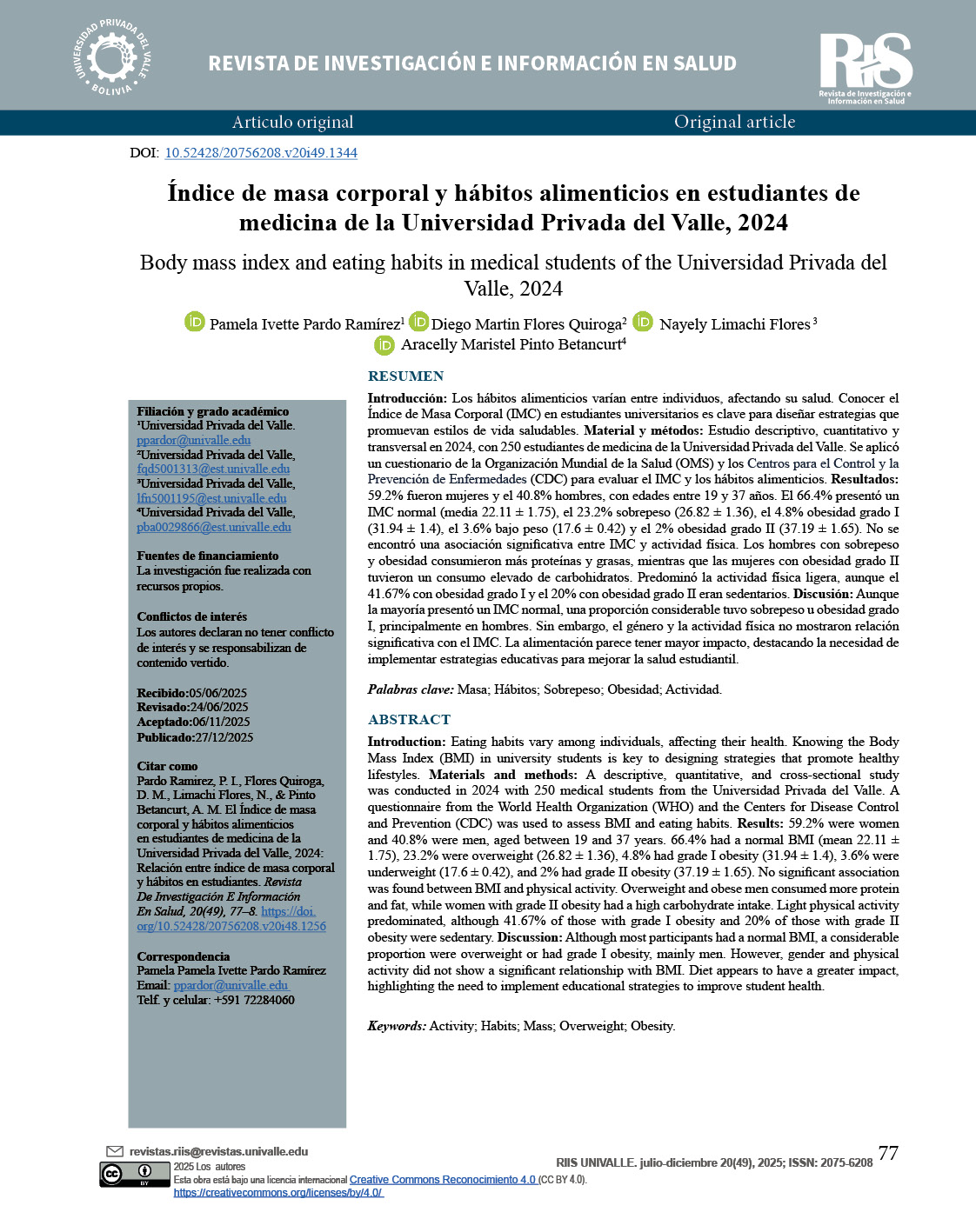
Introduction: Eating habits vary among individuals, affecting their health. Knowing the Body Mass Index (BMI) in university students is key to designing strategies that promote healthy lifestyles. Materials and methods: A descriptive, quantitative, and cross-sectional study was conducted in 2024 with 250 medical students from the Universidad Privada del Valle. A questionnaire from the World Health Organization (WHO) and the Centers for Disease Control and Prevention (CDC) was used to assess BMI and eating habits. Results: 59.2% were women and 40.8% were men, aged between 19 and 37 years. 66.4% had a normal BMI (mean 22.11 ± 1.75), 23.2% were overweight (26.82 ± 1.36), 4.8% had grade I obesity (31.94 ± 1.4), 3.6% were underweight (17.6 ± 0.42), and 2% had grade II obesity (37.19 ± 1.65). No significant association was found between BMI and physical activity. Overweight and obese men consumed more protein and fat, while women with grade II obesity had a high carbohydrate intake. Light physical activity predominated, although 41.67% of those with grade I obesity and 20% of those with grade II obesity were sedentary. Discussion: Although most participants had a normal BMI, a considerable proportion were overweight or had grade I obesity, mainly men. However, gender and physical activity did not show a significant relationship with BMI. Diet appears to have a greater impact, highlighting the need to implement educational strategies to improve student health.
Of the participants, 59.2% were women and 40.8% men, aged between 19 and 37. A normal BMI was found in 66.4% (mean 22.11 ± 1.75), overweight in 23.2% (26.82 ± 1.36), grade I obesity in 4.8% (31.94 ± 1.4), underweight in 3.6% (17.6 ± 0.42), and grade II obesity in 2% (37.19 ± 1.65). No statistically significant association was found between BMI and physical activity. Overweight and obese men consumed more proteins and fats, while women with grade II obesity had a high carbohydrate intake. Light physical activity was most common, although 41.67% of students with grade I obesity and 20% with grade II obesity were sedentary.
Although most students had a normal BMI, a significant proportion had overweight or grade I obesity, mainly in men. However, statistical analysis showed that neither gender nor physical activity significantly impacted BMI. Diet appeared to be the most influential factor. Implementing nutritional education and health strategies is crucial to reduce high BMI levels and improve student health.
Downloads
References
1. Organización Panamericana de la Salud. Más que una cuestión de peso [Internet]. Washington (DC): OPS; 2024 [citado 2024 Nov 27]. Disponible en: https://www.paho.org/es/noticias/7-3-2024-mas-que-cuestion-peso#:~:text=Seg%C3%BAn%20la%20Organizaci%C3%B3n%20Mundial%20de,en%20adolescentes%20se%20ha%20cuadruplicado paho.org
2. Gertler PJ, Martínez S, Premand P, Rawlings LB, Vermeersch CMJ. La evaluación de impacto en la práctica. 2ª ed. Washington (DC): Banco Interamericano de Desarrollo & Banco Mundial; 2017 [Internet]. Disponible en: http://www.worldbank.org/ieinpractice
3. Munideporte.com. [Internet]. Dieta mediterránea: de la teoría a la práctica. [citado 2024 Mar 23]. Disponible en: https://www.munideporte.com/imagenes/documentacion/ficheros/03248F2F.pdf munideporte.com+1
4. Centers for Disease Control and Prevention (CDC). Calculadora del IMC para adultos: sistema métrico [Internet]. Atlanta (GA): CDC; 2022 [citado 2024 Mar 23]. Disponible en: https://www.cdc.gov/healthyweight/spanish/assessing/bmi/adult_bmi/metric_bmi_calculator/bmi_calculator.html
5. Tabla de IMC 2024 de la OMS (mujeres y hombres adultos) [Internet]. Enterat.com; [citado 2024 Mar 23]. Disponible en: https://www.enterat.com/salud/imc-indice-masa-corporal.php
6. Escalante Cuadra AN, Villanueva Tantaleán FN, Méndez Rodríguez CL, Villalobos Vásquez F, Iglesias Osores S, Monsalve-Mera AE. Variación del índice de masa corporal en estudiantes de medicina de una universidad de Lambayeque durante los tres últimos años de su carrera. Correo Científico Médico. 2020;24(1). [Internet]. Disponible en: https://orcid.org/0000-0002-4974-4786
7. Autor(es). Conducta alimentaria, hábitos y enfermedades de estudiantes universitarios en Bolivia [Internet]. ResearchGate; 2024 [citado 2024 Nov 27]. Disponible en: https://www.researchgate.net/publication/374435366_Conducta_alimentaria_habitos_y_enfermedades_de_estudiantes_universitarios_en_Bolivia
8. Aguilar-Ydiáquez C, Campos-Flores L, Huamán-Saavedra JJ. Body mass index in medicine students: relationship with stress, eating habits and physical activity. Rev Fac Med Humana [Internet]. 2022 [citado 2024 Nov 29];22(2):359-66. Disponible en: http://www.scielo.org.pe/scielo.php?script=sci_arttext&pid=S2308-05312022000200359
9. Guapi-Guamán FI, Morcillo-Valencia RJ, Falcones-Barbosa E-D-R, Mina-Gonzáles JM. Prevalencia de sobrepeso y obesidad. Problema de salud en la comunidad universitaria y politécnica ecuatoriana. Vida y Salud [Internet]. 2022 [citado 2024 Nov 30];6(12):58. Disponible en: https://ve.scielo.org/scielo.php?script=sci_arttext&pid=S2610-80382022000200058
10. González Galeano MF, Cuenca Jara VL. Diferencias de género en la ingesta calórica y distribución de macronutrientes en usuarios de un gimnasio en Asunción. Rev Cient Estud Investig. 2022;11(1):98-108. DOI:10.26885/rcei.11.1.98
11. Ceballos-Macías JJ, Pérez Negrón-Juárez R, Flores-Real JA, Vargas-Sánchez J, Ortega-Gutiérrez G, Madriz-Prado R, et al. Obesidad. Pandemia del siglo XXI. Rev Sanid Milit [Internet]. 2018 [citado 2024 Mar 23];72(5–6):332-8. Disponible en: https://www.scielo.org.mx/scielo.php?pid=S0301696X2018000400332&script=sci_arttext
12. Causas de la Obesidad [Internet]. Clínic Barcelona. [citado 2024 Mar 23]. Disponible en: https://www.clinicbarcelona.org/asistencia/enfermedades/obesidad/causas-y-factores-de-riesgo
13. Meléndez JAB, Vega y León S, Vázquez CCR, Cervera SB, Hernández Nava LG, Rojo-Moreno L, et al. Hábitos alimentarios, actividad física y estilos de vida en adolescentes escolarizados de la Ciudad de México y del Estado de Michoacán [Internet]. Renc.es; [citado 2024 Mar 23]. Disponible en: https://www.renc.es/imagenes/auxiliar/files/RENC_2017_1_06._Vega_y_Leon__S._CONDUCTAS_ALIMENTARIAS_EN_ADOLESCENTES_DE_MICHOACAN.pdf
14. Berry R. Riesgos para la salud de tener un IMC bajo [Internet]. Muyfitness.com; Leaf Group; 2014 [citado 2024 Mar 23]. Disponible en: https://www.muyfitness.com/riesgos-salud-imc-info_32777/
15. Gómez-López L, Ayala-Rivera V, Moreno-Montoro M, García-Molina M, Olmedilla-Alonso B. Relación entre la calidad de la dieta (AHEI-2010) y el índice de masa corporal en población adulta española. Nutr Hosp. 2021;38(1):e100. DOI:10.20960/nh.03132.
16. Pineda-Díaz J, Quiroz-Barzola A, Pacheco-Ortiz J, Solórzano-Cáceres J. Hábitos alimenticios y sus efectos en la salud de los estudiantes universitarios: una revisión sistemática de 2015-2021. Psicogente. 2022;25(47):110. DOI:10.17081/psico.25.4861.
17. García-González A, González-Barrios JM, Martínez-Ramos L, Floriano-Monroy J, Rojo-Ruiz J. Índice de masa corporal, hábitos alimentarios y nivel de actividad física en adultos españoles. Nutr Hosp. 2021;38(1):e0100. DOI:10.20960/nh.3109.
18. Peñaloza-Gómez JL, Rivera-Hernández M, Benavides-Ochoa A, Vargas-Sánchez J, Gutiérrez-Ortega G. Estado nutricional y hábitos alimenticios en estudiantes colombianos de ciencias de la salud. Rev Salud Pública (Bogotá). 2022;24(1):e00110. DOI:10.15446/rsap.v24n1.00110.
19. Rincón-Robayo D, Rodríguez-Castro L, López-Díaz J. Índice de masa corporal y patrones de alimentación en población adulta de Bogotá, Colombia. Rev Salud Pública (Bogotá). 2018;20(2):145-54. DOI:10.15446/rsap.v20n2.61450.
20. Pico Fonseca S, Quiroz Mora C, Hernández Carrillo M, Arroyave Rosero G, Idrobo Herrera I, Burbano Cadavid L, Rojas Padilla I, Piñeros Suárez A. Relación entre el patrón de consumo de alimentos y la composición corporal de estudiantes universitarios: estudio transversal. Nutr Hosp. 2021;38(1):100-108. doi:10.20960/nh.03132.
Downloads
Published
How to Cite
Issue
Section
License
Copyright (c) 2025 Pamela Ivette Pardo Ramirez, Diego Martin Flores Quiroga, Nayely Limachi Flores, Aracelly Maristel Pinto Betancurt

This work is licensed under a Creative Commons Attribution 4.0 International License.
Authors who publish with this journal agree to the following terms:
- Authors retain copyright and grant the journal right of first publication with the work simultaneously licensed under a Creative Commons Attribution License 4.0 that allows others to share the work with an acknowledgement of the work's authorship and initial publication in this journal.
- Authors are able to enter into separate, additional contractual arrangements for the non-exclusive distribution of the journal's published version of the work (e.g., post it to an institutional repository or publish it in a book), with an acknowledgement of its initial publication in this journal.
- Authors are permitted and encouraged to post their work online (e.g., in institutional repositories or on their website) prior to and during the submission process, as it can lead to productive exchanges, as well as earlier and greater citation of published work.