The Evaluation of telemedicine as a training tool for kinesiology students: an experience in southern Chile
Evaluación de la telemedicina en estudiantes de kinesiología
DOI:
https://doi.org/10.52428/20756208.v20i49.1330Keywords:
Clinical training, Educational assessment, Kinesiology students, Medical education, TelemedicineAbstract
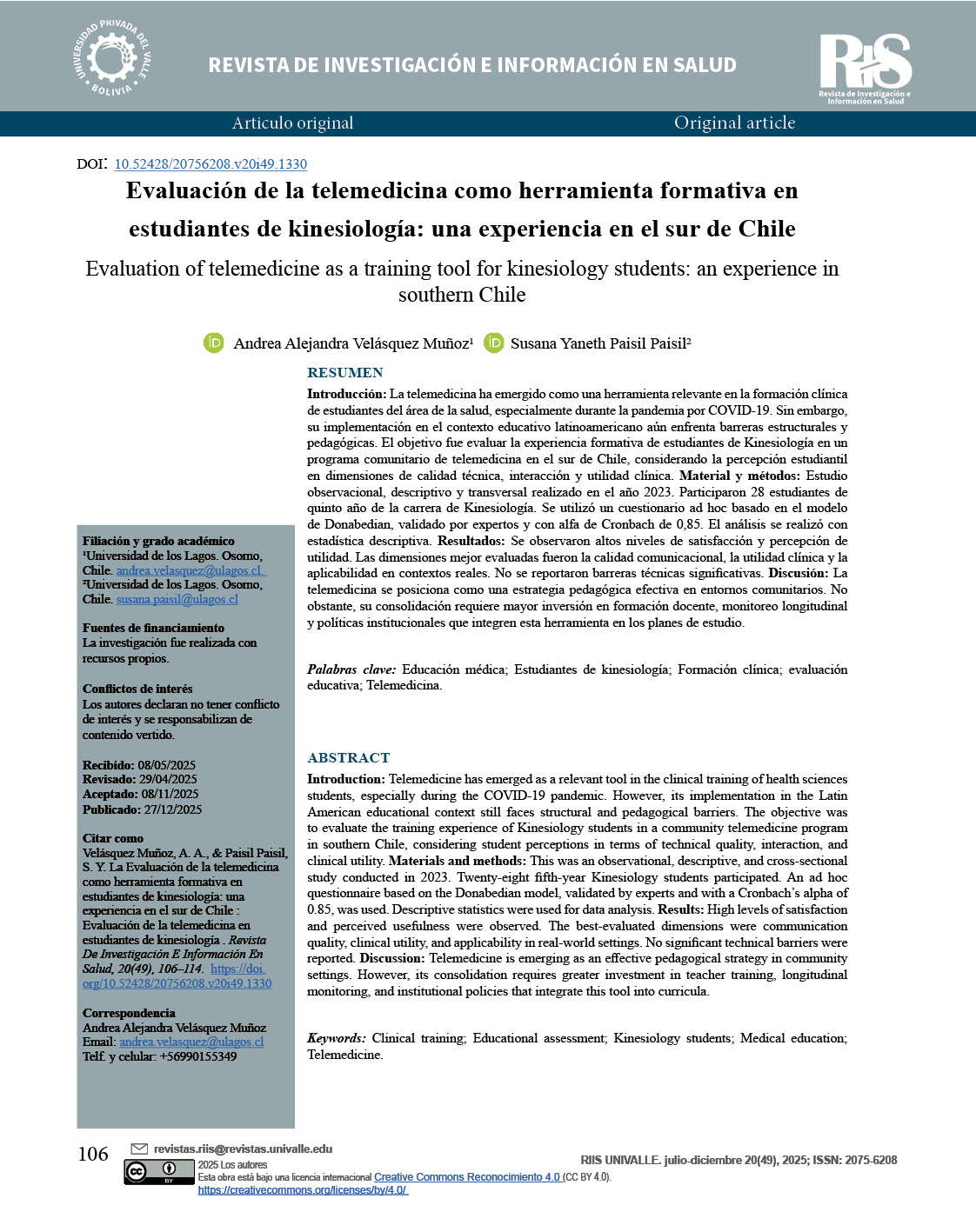
Introducción: La telemedicina ha emergido como una herramienta relevante en la formación clínica de estudiantes del área de la salud, especialmente durante la pandemia por COVID-19. Sin embargo, su implementación en el contexto educativo latinoamericano aún enfrenta barreras estructurales y pedagógicas. El objetivo fue evaluar la experiencia formativa de estudiantes de Kinesiología en un programa comunitario de telemedicina en el sur de Chile, considerando la percepción estudiantil en dimensiones de calidad técnica, interacción y utilidad clínica. Material y métodos: Estudio observacional, descriptivo y transversal realizado en el año 2023. Participaron 28 estudiantes de quinto año de la carrera de Kinesiología. Se utilizó un cuestionario ad hoc basado en el modelo de Donabedian, validado por expertos y con alfa de Cronbach de 0,85. El análisis se realizó con estadística descriptiva. Resultados: Se observaron altos niveles de satisfacción y percepción de utilidad. Las dimensiones mejor evaluadas fueron la calidad comunicacional, la utilidad clínica y la aplicabilidad en contextos reales. No se reportaron barreras técnicas significativas. Discusión: La telemedicina se posiciona como una estrategia pedagógica efectiva en entornos comunitarios. No obstante, su consolidación requiere mayor inversión en formación docente, monitoreo longitudinal y políticas institucionales que integren esta herramienta en los planes de estudio.
Downloads
References
1. Smith AC, Thomas E, Snoswell CL, Haydon H, Mehrotra A, Clemensen J, Caffery LJ. Telehealth for global emergencies: implications for coronavirus disease 2019 (COVID‑19). J Telemed Telecare [Internet]. 2020 [citado el 12 ene 2025];26(5):309‑13. Disponible en: https://doi.org/10.1177/1357633X20916567 DOI: https://doi.org/10.1177/1357633X20916567
2. O’Doherty J, Bouche D, Williams C, McGrath C, O’Connor M, Casey M, et al. Telemedicine in undergraduate clinical medical education: a scoping review. BMC Med Educ [Internet]. 2022 [citado el 29 oct 2024];22(1):78. Disponible en: https://doi.org/10.1186/s12909-022-03147-6
3. Waseh S, Dicker AP. Telemedicine training in undergraduate medical education: Mixed-methods review. JMIR Med Educ [Internet]. 2019 [citado 10 ene 2025];5(1): e12515. Disponible en: https://mededu.jmir.org/2019/1/e12515
4. Waseh S, Dicker AP. Telemedicine training in undergraduate medical education: Mixed-methods review. JMIR Med Educ [Internet]. 2019 [citado 16 ene 2025];5(1): e12515. Disponible en: https://mededu.jmir.org/2019/1/e12515 DOI: https://doi.org/10.2196/12515
5. Massucato MAO, Ribeiro ALG, Pessalacia JD, Neves VJ, Stolte‑Rodrigues VP. Telehealth as a medical education tool during the COVID‑19 pandemic: experience report. Rev Bras Educ Med [Internet]. 2021 [citado 29 oct 2024];45(3): e172. Disponible en: https://doi.org/10.1590/1981-5271v45.3-20210195 DOI: https://doi.org/10.1590/1981-5271v45.3-20210195.ing
6. Savedoff WD, Goyeneche L, Soler LA, Bernal P, Chávez M, Cardona J, Tejerina L. Disruption and Rebound: Healthcare and Telemedicine in Colombia during the COVID‑19 Pandemic for Chronic Care Patients [Internet]. Washington (DC): Inter‑American Development Bank; 2023 [citado 12 oct 2024]. Available from: https://doi.org/10.18235/0004865 DOI: https://doi.org/10.18235/0004865
7. Mercado-Cruz E, Morales-Acevedo JA, Lugo-Reyes G, Quintos-Romero AP, Esperón-Hernández RI. Telesimulación: una estrategia para desarrollar habilidades clínicas en estudiantes de medicina. Rev Fac Med UNAM [Internet]. 2021 [citado el 29 oct 2024];40: e21355. Disponible en: https://doi.org/10.22201/fm.20075057e.2021.40.21355 DOI: https://doi.org/10.22201/fm.20075057e.2021.40.21355
8. Villarroel S, Medina S. Telemedicina en Chile: uso, desarrollo y controversias en una red de salud pública del sur del país. Rev Chil Salud Pública [Internet]. 2022 [citado el 19 oct 2024];26(1):48‑57. Disponible en: https://revistasaludpublica.uchile.cl/ DOI: https://doi.org/10.5354/0719-5281.2022.69151
9. Donabedian A. Evaluating the quality of medical care. 1966. Milbank Q [Internet]. 2005 [citado el 9 oct 2024];83(4):691–729. Disponible en: https://doi.org/10.1111/j.1468-0009.2005.00397.x DOI: https://doi.org/10.1111/j.1468-0009.2005.00397.x
10. Kruse CS, Karem P, Shifflett K, Vegi L, Ravi K, Brooks M. Evaluating barriers to adopting telemedicine worldwide: a systematic review. J Telemed Telecare [Internet]. 2018 [citado el 2 oct 2024];24(1):4-12. Disponible en: https://doi.org/10.1177/1357633X16674087 DOI: https://doi.org/10.1177/1357633X16674087
11. Monaghesh E, Hajizadeh A. The role of telehealth during COVID-19 outbreak: a systematic review based on current evidence. BMC Public Health [Internet]. 2020 [citado el 29 ene 2025];20(1):1193. Disponible en: https://doi.org/10.1186/s12889-020-09301-4 DOI: https://doi.org/10.1186/s12889-020-09301-4
12. Mace S, Boccanelli A, Dormond M. The use of telehealth within behavioral health settings: utilization, opportunities, and challenges [Internet]. Ann Arbor (MI): Behavioral Health Workforce Research Center, University of Michigan; 2018 [citado el 2 oct 2024]. Disponible en: https://www.behavioralhealthworkforce.org/wp-content/uploads/2018/05/Telehealth-Full-Paper_5.17.18-clean.pdf
13. Silva BM, Rodrigues JJ, de la Torre Díez I, López-Coronado M, Saleem K. Mobile-health: A review of current state in 2015. J Biomed Inform [Internet]. 2015 Aug [citado el 25 oct 2024]; 56:265-72. Disponible en: https://doi.org/10.1016/j.jbi.2015.06.003 DOI: https://doi.org/10.1016/j.jbi.2015.06.003
14. Ohannessian R, Duong TA, Odone A. Global Telemedicine Implementation and Integration Within Health Systems to Fight the COVID-19 Pandemic: A Call to Action. JMIR Public Health Surveill [Internet]. 2020 Apr 2 [citado el 2 mar 2024];6(2):e18810. Disponible en: https://doi.org/10.2196/18810 DOI: https://doi.org/10.2196/18810
15. Gajarawala SN, Pelkowski JN. Telehealth benefits and barriers. J Nurse Pract [Internet]. 2021 [citado el 9 oct 2024];17(2):218–21. Disponible en: https://doi.org/10.1016/j.nurpra.2020.09.013 DOI: https://doi.org/10.1016/j.nurpra.2020.09.013
16. Edirippulige S, Armfield NR. Education and training to support the use of clinical telehealth: a review of the literature. J Telemed Telecare [Internet]. 2017 [citado el 2 oct 2024];23(2):273–82. Disponible en: https://doi.org/10.1177/1357633X16632968 DOI: https://doi.org/10.1177/1357633X16632968
17. Litewka S. Telemedicine: a challenge for Latin America. Acta Bioeth [Internet]. 2005 [cited 05 Dec 2024];11(2):127–32. Available from: http://www.scielo.cl/scielo.php?script=sci_arttext&pid=S1726-569X2005000200003&lng=es&nrm=iso
18. Díaz de León Castañeda C, Góngora Ortega J. eSalud en servicios de salud públicos en México: estudio de caso. Región y Soc [Internet]. 2020 [citado el 03 marzo 2025];32. Disponible en: https://doi.org/10.22198/rys2020/32/1256 DOI: https://doi.org/10.22198/rys2020/32/1256
19. Llaguno Ayala S V, Briones Morales V E. Análisis del uso de telemedicina para mejorar la gestión de salud en pacientes de zonas rurales. [Internet]. [s.l.]: [s.n.]; [citado el 05 julio 2025]. Disponible en: https://orcid.org/0009-0004-7825-4868
20. Dos Santos AF, Fernández A, editores. Desarrollo de la telesalud en América Latina: aspectos conceptuales y estado actual. Santiago de Chile: [s.n.]; 2013.
21. Kunutsor SK, Metcalf EP, Westacott R, Revell L, Blythe A. Are remote clinical assessments a feasible and acceptable assessment method? A systematic review. Med Teach [Internet]. 2022 [cited 9 Nov 2024];44(3):300–8. Available from: https://doi.org/10.1080/0142159X.2021.1965502 DOI: https://doi.org/10.1080/0142159X.2021.1987403
22. Nasseri A, Zhou T, Ha V, Zhu J, Wu D, Ohyama H. Students’ perceptions of interactive virtual case-based learning: a comparative study with three different cohorts. J Dent Sci [Internet]. 2023 [cited 24 Oct 2024];19(3):1578–86. Available from: https://doi.org/10.1016/j.jds.2023.12.018 DOI: https://doi.org/10.1016/j.jds.2023.12.018
23. Foronda CL, Fernández-Burgos M, Nadeau C, Kelley CN, Henry MN. Virtual simulation in nursing education: a systematic review from 1996 to 2018. Simul Healthc [Internet]. 2020 [cited 02 Mar 2025];15(1):46–54. Available from: https://doi.org/10.1097/SIH.0000000000000411 DOI: https://doi.org/10.1097/SIH.0000000000000411
24. Fogg N, Wilson C, Trinka M, Campbell R, Thomson A, Merritt L, Tietze M, Prior M. Transition from direct patient care to virtual clinical experiences during the COVID-19 pandemic. Prof Nurse [Internet]. 2021 [cited 01 Feb 2025];37(2):100–6. Available from: https://doi.org/10.1016/j.profnurs.2020.09.012 DOI: https://doi.org/10.1016/j.profnurs.2020.09.012
25. Gormley GJ, Collins K, Boohan M, Bickle IC, Stevenson M. Is there a place for e-learning in clinical skills? A survey of undergraduate medical students’ experiences and attitudes. Med Teach [Internet]. 2009 [cited 16 Apr 2025];31(1):e6–e12. Available from: https://doi.org/10.1080/01421590802334317 DOI: https://doi.org/10.1080/01421590802334317
26. Iancu AM, Kemp MT, Alam HB. Unmuting medical students’ education: utilizing telemedicine during the COVID-19 pandemic and beyond. J Med Internet Res [Internet]. 2020 [citado el 12 enero 2025];22(7):e19667. Disponible en: https://doi.org/10.2196/19667 DOI: https://doi.org/10.2196/19667
27. World Health Organization. Global strategy on digital health 2020–2025. Geneva: WHO; 2021.
28. Figueroa CA, Aguilera A. The need for a mental health technology revolution in the COVID-19 pandemic. Front Psychiatry [Internet]. 2020 [citado el 9 enero 2025]; 11:523. Disponible en: https://doi.org/10.3389/fpsyt.2020.00523 DOI: https://doi.org/10.3389/fpsyt.2020.00523
Downloads
Published
How to Cite
Issue
Section
License
Copyright (c) 2025 Andrea Alejandra Velásquez Muñoz, Susana Yaneth Paisil Paisil

This work is licensed under a Creative Commons Attribution 4.0 International License.
Authors who publish with this journal agree to the following terms:
- Authors retain copyright and grant the journal right of first publication with the work simultaneously licensed under a Creative Commons Attribution License 4.0 that allows others to share the work with an acknowledgement of the work's authorship and initial publication in this journal.
- Authors are able to enter into separate, additional contractual arrangements for the non-exclusive distribution of the journal's published version of the work (e.g., post it to an institutional repository or publish it in a book), with an acknowledgement of its initial publication in this journal.
- Authors are permitted and encouraged to post their work online (e.g., in institutional repositories or on their website) prior to and during the submission process, as it can lead to productive exchanges, as well as earlier and greater citation of published work.