
THE EVOLUTION OF DEMOCRATIC CULTURE IN LIGHT OF THE PROCESSES FOR ELECTING JUDICIAL AUTHORITIES IN BOLIVIA.
DOI:
https://doi.org/10.52428/30074320.v2i4.1432Keywords:
Cultura democrática, Elecciones judiciales, Legitimidad institucional, Independencia judicial, Voto popular, Tribunal Constitucional Plurinacional, Autoprórrogas Injerencia política, Participación ciudadana, Reforma judicialAbstract
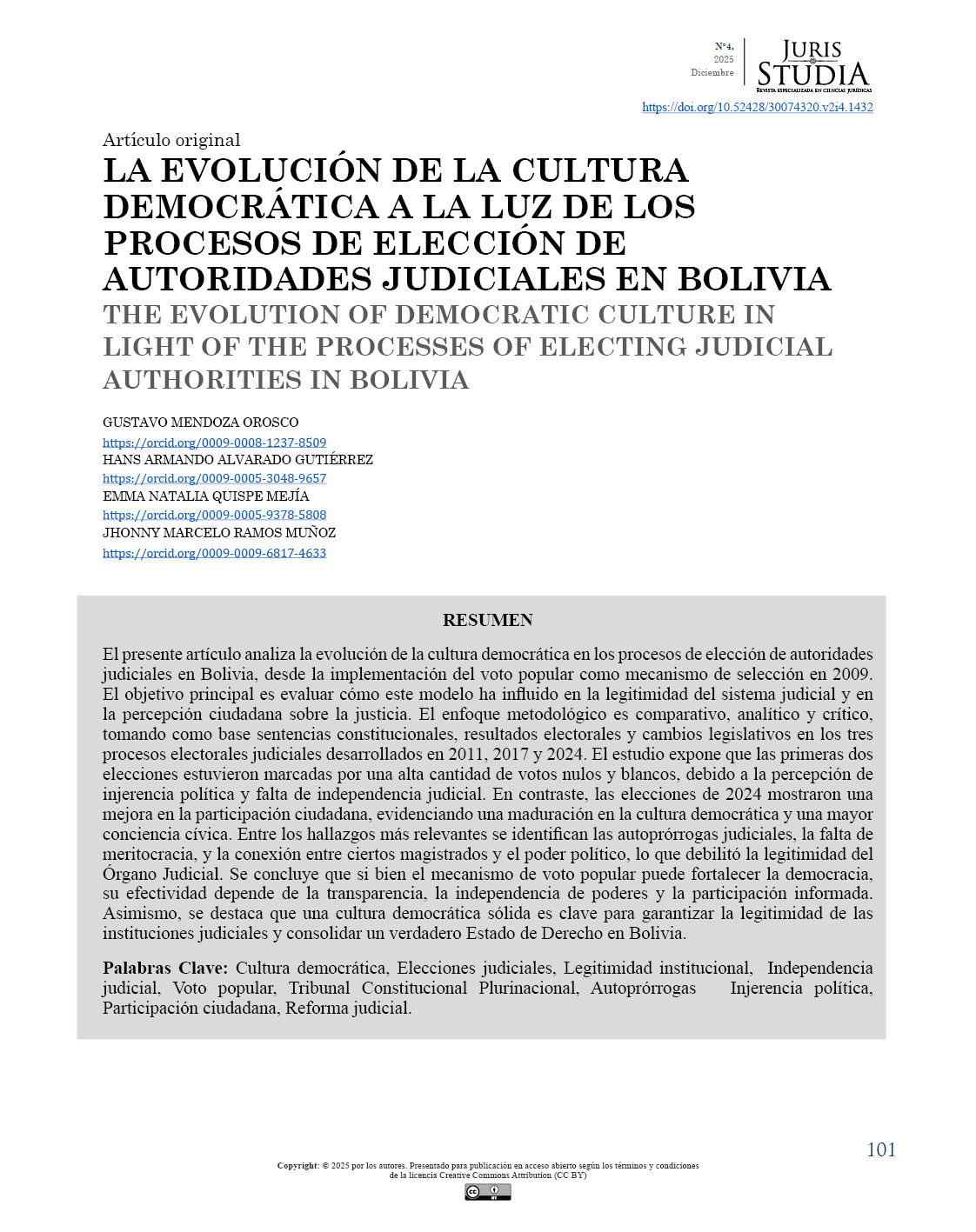
This article analyzes the evolution of democratic culture in the processes of electing judicial authorities in Bolivia, particularly since the implementation of popular vote as a selection mechanism in 2009. The main objective is to assess how this model has influenced the legitimacy of the judicial system and public perception of justice. The methodological approach is comparative, analytical, and critical, based on constitutional rulings, electoral results, and legislative changes in the three judicial elections held in 2011, 2017, and 2024. The study reveals that many null and blank votes marked the first two elections due to perceived political interference and a lack of judicial independence. In contrast, the 2024 elections showed improved citizen participation, indicating a maturing democratic culture and greater civic awareness. Key findings include judicial term extensions, lack of meritocracy, and ties between some magistrates and political power, which undermined the legitimacy of the Judicial Branch. The article concludes that while the popular vote mechanism can strengthen democracy, its effectiveness depends on transparency, power separation, and informed participation. Moreover, it emphasizes that a strong democratic culture is essential to ensure the legitimacy of judicial institutions and consolidate a true Rule of Law in Bolivia.
References
Asamblea Legislativa Plurinacional de Bolivia. (2010). Ley N.º 025 de 24 de junio de 2010: Ley del Órgano Judicial. Gaceta Oficial del Estado Plurinacional.
Asamblea Legislativa Plurinacional de Bolivia. (2010). Ley N.º 027 de 06 de julio de 2010: Ley del Tribunal Constitucional Plurinacional. Gaceta Oficial del Estado Plurinacional.
Asamblea Legislativa Plurinacional de Bolivia. (2024). Ley N.º 1549 de 6 de febrero de 2024: Ley Transitoria para las Elecciones Judiciales 2024. Gaceta Oficial del Estado Plurinacional de Bolivia.
Basham Ringe y Correa S.C. (2024, diciembre 31). Nueva Ley Orgánica del Poder Judicial de la Federación. Member firm of First Law International. https://surl.li/hshcjd
Bolivia, único país del mundo en elegir los jueces por voto popular. (2017, febrero 12). Nuevatribuna.es. https://surl.li/gtnoaq
Cadena, S. E. R. (2022, septiembre 11). "Ensayo sobre la lucidez", una necesaria reflexión sobre la democracia. Cadena SER. https://surl.li/cjizpq
Comisión Interamericana de Derechos Humanos (CIDH). (2010). El derecho de acceso a la información en el marco jurídico interamericano. https://surl.lu/xluptv
Congreso Nacional de Bolivia. (1993). Ley N.º 1455 de 18 de febrero de 1993: Ley de Organización Judicial. Gaceta Oficial del Estado.
Congreso Nacional de Bolivia. (1998). Ley N.º 1836 de 01 de abril de 1998: Ley del Tribunal Constitucional. Gaceta Oficial del Estado.
Declaración Constitucional Plurinacional 003/2013. De 25 de abril de 2013.
Easton, D. (1965). Un análisis de sistemas de la vida política. ER.
Fundación CONSTRUIR. (2020). Estado de la Justicia en Bolivia 2019. Plataforma Ciudadana por el Acceso a la Justicia y los Derechos Humanos. https://surl.lt/hdoopw
Mendoza. (2024). El quebranto el Estado de Derecho en Bolivia, en la última década. Juris Studia. https://revistas.univalle.edu/index.php/iuris/article/view/1130/1336 https://doi.org/10.52428/30074320.v1i2.1130
https://doi.org/10.52428/30074320.v1i2.1130
Montesquieu. (2017). El Espíritu de las Leyes. Createspace Independent Publishing Platform.
Noticias Fides, A. (s/f-a). Bolivia gastó Bs 225 millones en dos elecciones de jueces plagadas de observaciones y denuncias. Noticiasfides.com. https://surl.li/smwqnb
Noticias Fides, A. (s/f-b). La preselección judicial carece de legitimidad y la elección será peor que el 2011 y 2017. Noticiasfides.com. https://surl.li/profpl
Norris, P. (2011). Democratic deficit: Critical citizens revisited. Cambridge University Press. https://doi.org/10.1017/CBO9780511973383
https://doi.org/10.1017/CBO9780511973383
Sentencia Constitucional Plurinacional 084/2017. De 28 de noviembre de 2017.
Sentencia Constitucional Plurinacional 049/2023. De 11 de diciembre de 2023.
Sentencia Constitucional Plurinacional 007/2025. De 13 de mayo de 2025.
Villaescusa, R. R. (2015). Independencia e imparcialidad, transparencia y rendición de cuentas: reflexiones desde el ámbito de la justicia. Revista Alegatos, (91), 497-524.
Downloads
Published
How to Cite
Issue
Section
License
Copyright (c) 2025 Dr. Gustavo Mendoza Orosco , Hans Armando Alvarado Gutierrez, Emma Natalia Quispe Mejia , Jhonny Marcelo Ramos Muñoz

This work is licensed under a Creative Commons Attribution 4.0 International License.
Authors who publish with this journal agree to the following terms:
- Authors retain copyright and grant the journal right of first publication with the work simultaneously licensed under a Creative Commons Attribution License 4.0 that allows others to share the work with an acknowledgement of the work's authorship and initial publication in this journal.
- Authors are able to enter into separate, additional contractual arrangements for the non-exclusive distribution of the journal's published version of the work (e.g., post it to an institutional repository or publish it in a book), with an acknowledgement of its initial publication in this journal.
- Authors are permitted and encouraged to post their work online (e.g., in institutional repositories or on their website) prior to and during the submission process, as it can lead to productive exchanges, as well as earlier and greater citation of published work.