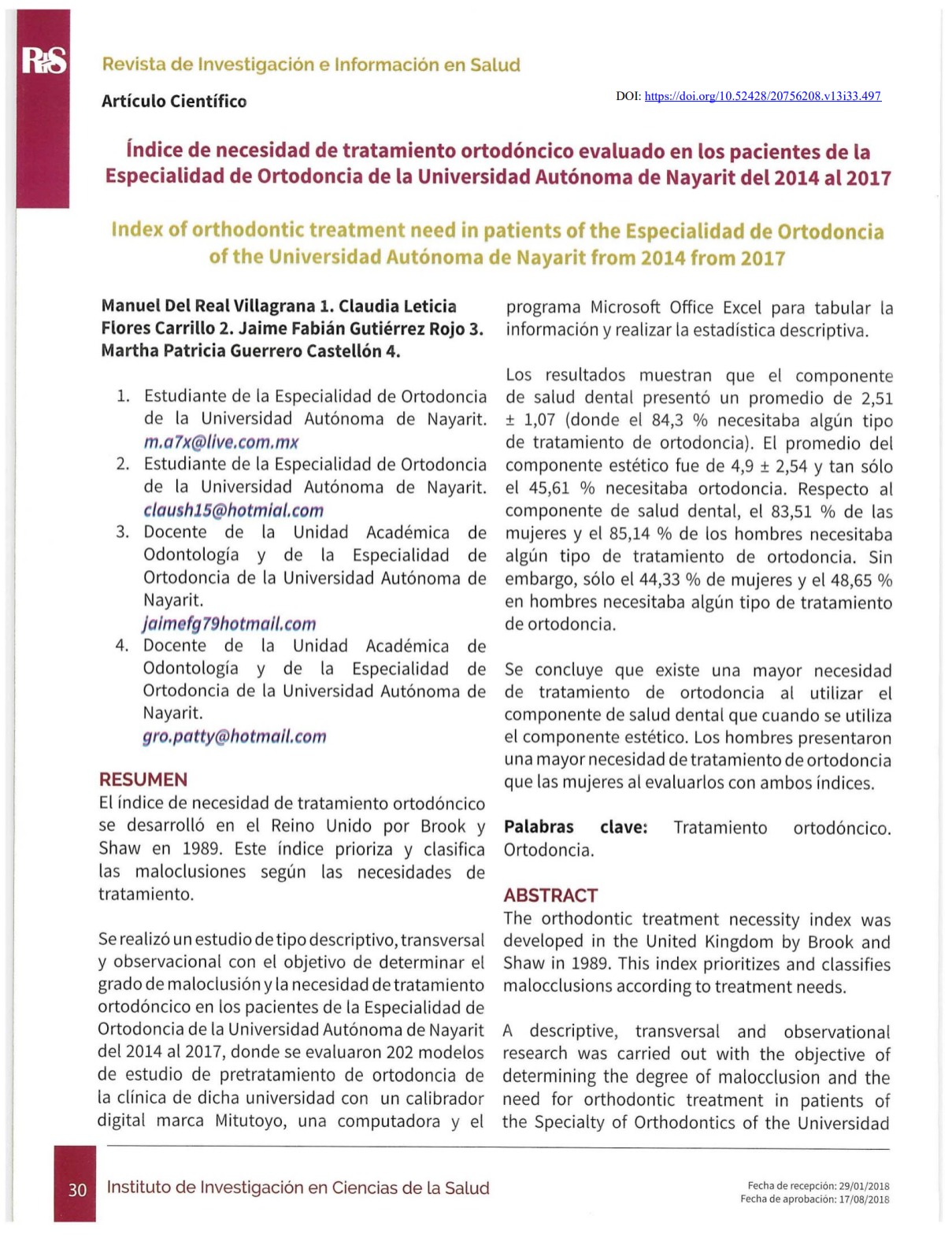
Índice de Necesidad de Tratamiento Ortodóncico Evaluado en los Pacientes de la Especialidad de Ortodoncia de la Universidad Autónoma de Nayarit del 2014 al 2017
DOI:
https://doi.org/10.52428/20756208.v13i33.497Palabras clave:
Tratamiento ortodóncico, OrtodonciaResumen
El índice de necesidad de tratamiento ortodóncico se desarrolló en el Reino Unido por Brook y Shaw en 1989. Este índice prioriza y clasifica las maloclusiones según las necesidades de tratamiento. Se realizó un estudio de tipo descriptivo, transversal y observacional con el objetivo de determinar el grado de maloclusión y la necesidad de tratamiento ortodóncico en los pacientes de la Especialidad de Ortodoncia de la Universidad Autónoma de Nayarit del 2014 al 2017, donde se evaluaron 202 modelos de estudio de pretratamiento de ortodoncia de la clínica de dicha universidad con un calibrador digital marca Mitutoyo, una computadora y el programa Microsoft Office Excel para tabular la información y realizar la estadística descriptiva. Los resultados muestran que el componente de salud dental presentó un promedio de 2,51 ± 1,07 (donde el 84,3 % necesitaba algún tipo de tratamiento de ortodoncia). El promedio del componente estético fue de 4,9 ± 2,54 y tan sólo el 45,61 % necesitaba ortodoncia. Respecto al componente de salud dental, el 83,51 % de las mujeres y el 85,14 % de los hombres necesitaba algún tipo de tratamiento de ortodoncia. Sin embargo, sólo el 44,33 % de mujeres y el 48,65 % en hombres necesitaba algún tipo de tratamiento de ortodoncia. Se concluye que existe una mayor necesidad de tratamiento de ortodoncia al utilizar el componente de salud dental que cuando se utiliza el componente estético. Los hombres presentaron una mayor necesidad de tratamiento de ortodoncia que las mujeres al evaluarlos con ambos índices.
Descargas
Referencias
1. AGUILAR N. y TABOADA O. Frecuencia de malocluciones y su asociación con problemas de postura corporal en una población escolar del Estado de México. Bol Med Hosp lnfant Mex. México; 2013. 70(5):364-37.
2. PINO 1, VÉLIZ O y GARCÍA P. Maloclusiones, según el indice de estética dental en estudiantes de séptimo grado de Santa Clara. Medicent Electrón. Cuba; 2014.18(4):177-9.
3. ALEMÁN M, MARTÍNES I y Pérez A. Índice de estética dental y criterio profesional para determinar la necesidad de tratamiento ortodóntico. Rev Med Electron. Cuba; 2011. 33(3): 271-277.
4. AYALA A, ROJAS A, GUTIÉRREZ J y MATA F. Determinación de la necesidad de tratamiento de ortodoncia en población de Tepic Nayarit, México. Acta Odontológica Colombiana. Colombia; 2014. 4(1): 131-8.
5. ENDARRA L, TANG B y LISA L. Correlation of orthodontic treatment demand with treatment need assessed using two indices, The Angle Orthodontist. United States; 1995. 65 (6): 443-450.
6. BHAGYALAKSHMI A, SHIVALINGA B-M, BALASUBRAMANIAN S y SUMA S. The index of orthodontic treatment need a review. lnternational Journal of Recent Scientific Research. Netherlands; 2015. 6(8): 5835-9.
7. CARDOSO C, DRUMMOND A, LAGES E, PRETTI H, FERREIRA E, ABREU M. The Dental Aesthetic lndex and Dental Health Componen of the lndex of Orthodontic Treatment Need as Tools in Epidemiological Studies. lnt. J. Enviran. Res. Public Health. Switzerland; 2011. 8: 3277-3286. https://doi.org/10.3390/ijerph8083277
8. ELIZONDO R, YUDOVICH M, AGUILAR-M y MELÉNDEZ A. Propuesta de un índice de maloclusiones invalidantes con potencial de deterioro y su aplicación. Rev Odont Mex. México, 2011.15 (2): 77-95.
9. CASTRO C, FERNÁNDEZ M, CARRASCO R, LEZAMA G, VAILLARD E, BARCIELA M. Índices epidemiológicos orales. BUAP. México. 2009:65-69.
10. GUTIÉRREZ M, GUTIÉRREZ J, GUTIÉRREZ J y ROJAS A. Necesidad de tratamiento ortodóntico utilizando el Índice Estética Dental (DAI) en una población de Guadalajara, Jalisco, México. Acta Odontológica Colombiana. Colombia; 2016. 6(1): 99-106.
11. PÉREZ V, GARCÍAG, CÁRDENAS G, CARRASCO R, CASTRO C, LEZAMMAG yVAILLARD E. Índice Estética Dental (DAI) y necesidad de tratamiento ortodóncico en escolares, verano 2007. Oral. México; 2008. 9 (29):472-5.
12. DEGUCHI T, HONJO T, FUKUNAGA T, MIYAWAKI S, ROBERTS W y TAKANO T. Clinical assessment of orthodontic outcomes with the peer assessment rating, discrepancy index, objective granding system and comprehensive clinical assessment. Am J Orthod Dentofacial Orthop. United States; 2005. 434-43. https://doi.org/10.1016/j.ajodo.2004.03.030
13. OCHI C y BEGOLE E. Relationship between index of complexity, outcome and need, dental aesthetic index, peer assessment rating index, and American Board of Orhtodontics objective grading system. Am J Orthod Dentofacial Orthop. United States; 2007. 131:248-52. https://doi.org/10.1016/j.ajodo.2005.04.045
14. LINDA I y OCHI C. Orthodontic treatment complexity and Need in a Nigerian Teaching Hospital. Oral Health Dent Manag. United States; 2014.13 (3): 562-7.
15. CONS NC, JENNY J, KOHOUT FJ, SONGPAISAN Y y JOTIKASTIRA D. Utility of the dental aesthetic index in industrialized and developing countries. J. Public Health Dent. United States; 1989. 49: 163-166. https://doi.org/10.1111/j.1752-7325.1989.tb02054.x
16. DE OLIVEIRA CM, SHEIHAM A, TSAKOS G y O'BRIEN KD. Oral Health related quality of life and IOTN indexas predictors of children's perceived needs and acceptance far orthodontic treatment. Br Dent J. United Kingdom; 2008. 204(7):1-5. https://doi.org/10.1038/bdj.2008.239
17. JOSEFSSON E, BJERKLIN K y LINDSTEN R. Malocclusion frequency in Swedish and immigrant adolescents influence of origin on orthodontic treatment need, European Journal of Orthodontics. United Kingdom; 2007. 29: 79-87. https://doi.org/10.1093/ejo/cjl054
18. LARSSON B y BERGSTROM K. Adolescents perception of the quality of orthodontic treatment, Scand J Caring Sci. Scandinavia; 2005. 19 (2):95-101. https://doi.org/10.1111/j.1471-6712.2005.00325.x
19. BROOK P y SHAW W. The development of an index of orthodontic treatment priority. Eur J Orthod. United Kingdom; 1989. ll(3):309-20. https://doi.org/10.1093/oxfordjournals.ejo.a035999
20. KOK Y, MAGESON P, HARRADINE N y SPROD A. Comparinga quality of life measure and theAesthetic Componen of the lndex of Orthodontic Treatment Need (IOTN) in assessing orthodontic treatment need and concern. Journal of Orthodontics. United Kingdom; 2004. 31: 312-318. https://doi.org/10.1179/146531204225020625
21. HUNT O, HEPPER P, JOHNSTON C, STEVENSON M y SURDEN D. The Aesthetic Componen of the lndex of Orthodontic Treatment Need validated against lay opinion. Eur J Orthod. United Kingdom; 2002. 24 (1): 53-59. https://doi.org/10.1093/ejo/24.1.53
22. AVILÉS M, HUITZIL E, FERNÁNDEZ M yVIERNA J. Índice de necesidad de tratamiento ortodóncico (IOTN). Oral. México; 2011. 39: 782-785.
23. GUTIÉRREZ M, GUTIÉRREZ J, GUTIÉRREZ J y ROJAS A. indice de Necesidad de Tratamiento Ortodóncico (IOTN) en una población de Guadalajara, Jalisco, México. Ortodoncia Actual. México; 2016.12(48):28-32. https://doi.org/10.52428/20756208.v12i30.510
24. CHAPEL ROAD ORTHODONTICS. lndex OfTreatment Need (IOTN) [Internet] [consultado el 22 de agosto de 2017]. Disponible en: http://www.chapelroad.co.uk/PDF's/lOTN.pdf
25. CRUZ-LÓPEZ M, GUTIÉRREZ-ROJO M, GUTIÉRREZ-ROJO J y ROJAS-GARCÍA A. Comparación de los índices ICON y el componente estético del IOTN para determinar la necesidad de tratamiento ortodóncico. Revista Mexicana de Ortodoncia. México; 2017. 5 (1): 11-14. https://doi.org/10.1016/j.rmo.2017.03.020
26. NAKAS N, TIRO A, REDZEPAGIC L, HADZIHASANOVIC y DZEMIDZIC V. Use of orthodontic treatment needs indices far oral health survey. Mater Sociomed. Bosnia Herzegovina; 2016. 28(2): 138-140. https://doi.org/10.5455/msm.2016.28.138-140
27. MANCCINI M. Necesidad de tratamiento ortodóntico según el índice de necesidad de tratamiento ortodóntico en escolares de 12 a 13 años. Tesis para optar el título de Cirujano Dentista. Lima. 2011: 96.
28. CAMILLERI S y MULLIGAN K. The prevalence of malocclusion in Maltese school children as measured by the lndex of Orthodontic Treatment Need. Malta Medica! Journal. Malta; 2007. 19 (1):19-24.
29. CORNEAGA A, DANILA I y BALCOS C. Assessment of Orthodontic treatment needs of schoolchildren from lasi according to index of orthodontic treatment needs (IOTN) and dental aesthetic index (DAI). Romanian Journal of Oral Rehabilitation. Romanía; 2011. 3 (4): 27-32.
30. SHARMA J y DHIR R. IOTN-A tool to prioritize treatment need in children and plan health servives. Oral Health Dent Manag. United States; 2014. 13 (1): 65-70.
31. SOL y TANGE. A comparative study using the Occlusal lndex and the lndex of Orthodontic Treatment Need. Angle Orhtod. United States; 1993. 63 (1):57-64.
32. BOURNE C y SA B. Orthodontic treatment need of children in Trinidad and Tobago. West lndian Med J. lndian; 2012. 61(2):180-6.
33. MUNGOZIBWA E, KUIJPERS A, A VAN M y KIKWLU E. Perceptions of dental attractiveness and orthodontic treatment need among Tanzanian children. American Journal of Orthodontics and Dentofacial Orthopedics. United States; 2004. 125 (4):433-434. https://doi.org/10.1016/j.ajodo.2003.11.002
34. FOX N, DANIELS C y GILGRASS T. A comparison of the index of Complexity Outcome and Need (ICON) with the Peer Assessment Rating (PAR) and the lndex of Orthodontic Treatment Need (IOTN). British Dental Journal. United Kingdom; 2002. 193 (4): 225-30. https://doi.org/10.1038/sj.bdj.4801530
Descargas
Publicado
Número
Sección
Licencia
Derechos de autor 2018 Manuel Del Real Villagrana, Claudia Leticia Flores Carrillo , Jaime Fabián Gutiérrez Rojo y Martha Patricia Guerrero Castellón

Esta obra está bajo una licencia internacional Creative Commons Atribución 4.0.
Los autores/as que publiquen en esta revista aceptan las siguientes condiciones:
- Los autores/as conservan los derechos de autor y ceden a la revista el derecho de la primera publicación, con el trabajo registrado con la licencia de atribución de Creative Commons 4.0, que permite a terceros utilizar lo publicado siempre que mencionen la autoría del trabajo y a la primera publicación en esta revista.
- Los autores/as pueden realizar otros acuerdos contractuales independientes y adicionales para la distribución no exclusiva de la versión del artículo publicado en esta revista (p. ej., incluirlo en un repositorio institucional o publicarlo en un libro) siempre que indiquen claramente que el trabajo se publicó por primera vez en esta revista.
- Se permite y recomienda a los autores/as a compartir su trabajo en línea (por ejemplo: en repositorios institucionales o páginas web personales) antes y durante el proceso de envío del manuscrito, ya que puede conducir a intercambios productivos, a una mayor y más rápida citación del trabajo publicado.
Cómo citar