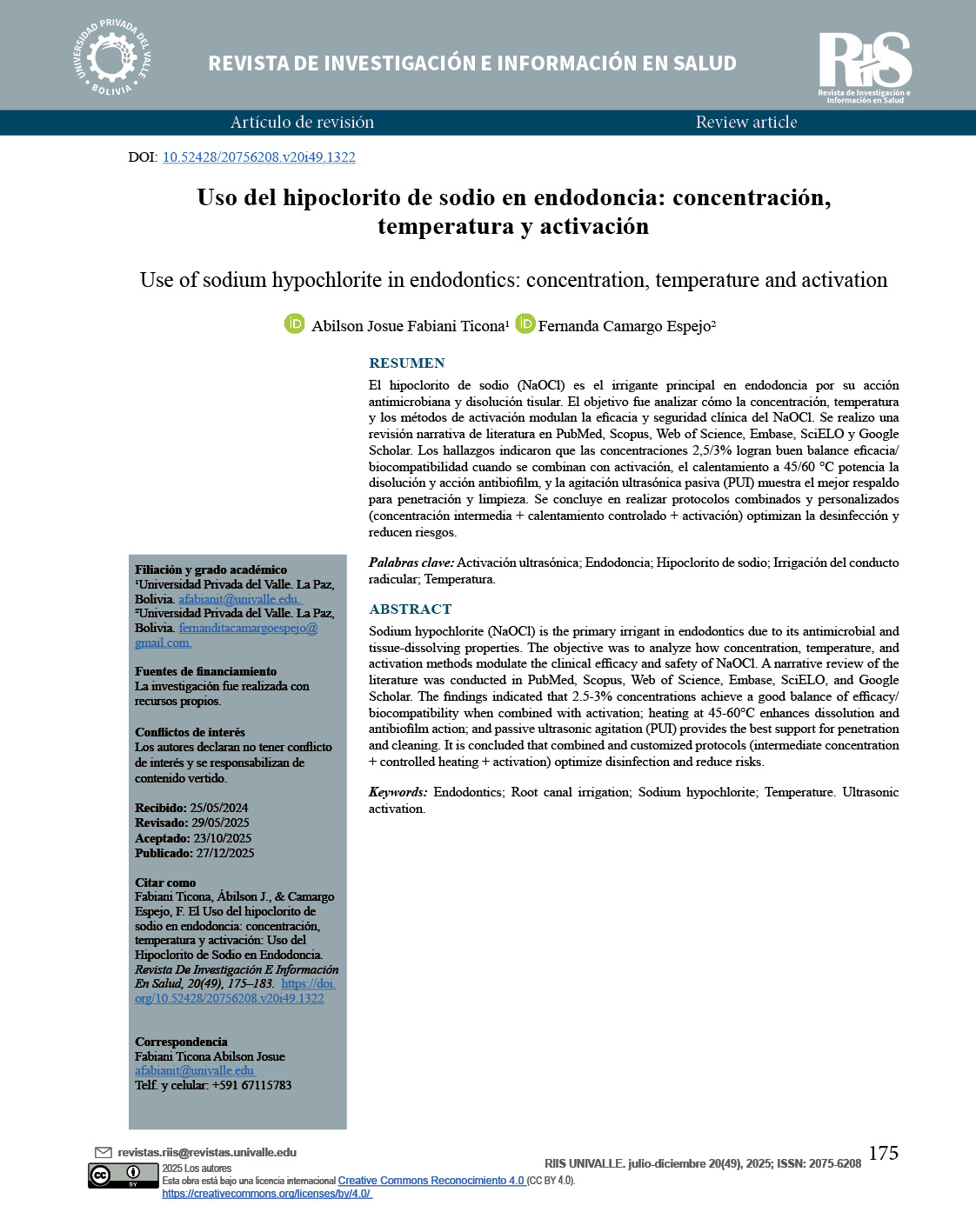
El Uso del hipoclorito de sodio en endodoncia: concentración, temperatura y activación
Uso del Hipoclorito de Sodio en Endodoncia
DOI:
https://doi.org/10.52428/20756208.v20i49.1322Palabras clave:
Activación ultrasónica, Endodoncia, Hipoclorito de sodio, Irrigación del conducto radicular, TemperaturaResumen
El hipoclorito de sodio (NaOCl) es el irrigante principal en endodoncia por su acción antimicrobiana y disolución tisular. El objetivo fue analizar cómo la concentración, temperatura y los métodos de activación modulan la eficacia y seguridad clínica del NaOCl. Se realizo una revisión narrativa de literatura en PubMed, Scopus, Web of Science, Embase, SciELO y Google Scholar. Los hallazgos indicaron que las concentraciones 2,5/3% logran buen balance eficacia/biocompatibilidad cuando se combinan con activación, el calentamiento a 45/60 °C potencia la disolución y acción antibiofilm, y la agitación ultrasónica pasiva (PUI) muestra el mejor respaldo para penetración y limpieza. Se concluye en realizar protocolos combinados y personalizados (concentración intermedia + calentamiento controlado + activación) optimizan la desinfección y reducen riesgos.
Descargas
Citas
1. Zehnder M. Root canal irrigants. J Endod [Internet]. 2006 May;32(5):389–98. [citado el 2 de marzo de 2025]. Disponible en: https://doi.org/10.1016/j.joen.2005.09.014 DOI: https://doi.org/10.1016/j.joen.2005.09.014
2. Estrela C, Estrela CRA, Barbin EL, Spanó JCE, Marchesan MA, Pécora JD. Mechanism of action of sodium hypochlorite. Braz Dent J [Internet]. 2002 feb;13(2):113–7. [citado el 6 de marzo de 2025]. Disponible en: https://doi.org/10.1590/S0103-64402002000200007 DOI: https://doi.org/10.1590/S0103-64402002000200007
3. Gomes BPF, Aveiro E, Kishen A. Irrigants and irrigation activation systems in endodontics. Braz Dent J [Internet]. 2023 oct 27;34(4):1–33. [citado el 10 de marzo de 2025]. Disponible en: https://doi.org/10.1590/0103-6440202305124 DOI: https://doi.org/10.1590/0103-6440202305577
4. Hand RE, Smith ML, Harrison JW. Analysis of the effect of dilution on the necrotic tissue dissolution property of sodium hypochlorite. J Endod [Internet]. 1978 feb;4(2):60–4. [citado el 11 de marzo de 2025]. Disponible en: https://doi.org/10.1016/S0099-2399(78)80123-7 DOI: https://doi.org/10.1016/S0099-2399(78)80255-6
5. Cunningham WT, Balekjian AY. Effect of temperature on collagen-dissolving ability of sodium hypochlorite endodontic irrigant. Oral Surg Oral Med Oral Pathol [Internet]. 1980;49(2):175–7. [citado el 13 de marzo de 2025]. Disponible en: https://doi.org/10.1016/0030-4220(80)90213-3 DOI: https://doi.org/10.1016/0030-4220(80)90313-8
6. Sirtes G, Waltimo T, Schaetzle M, Zehnder M. The effects of temperature on sodium hypochlorite short-term stability, pulp dissolution capacity, and antimicrobial efficacy. J Endod [Internet]. 2005 Sep;31(9):669–71. [citado el 15 de marzo de 2025]. Disponible en: https://doi.org/10.1097/01.don.0000164130.02062.6d DOI: https://doi.org/10.1097/01.don.0000153846.62144.d2
7. van der Sluis LWM, Versluis M, Wu MK, Wesselink PR. Passive ultrasonic irrigation of the root canal: a review of the literature. Int Endod J [Internet]. 2007 jun;40(6):415–26. [citado el 17 de marzo de 2025]. Disponible en: https://doi.org/10.1111/j.1365-2591.2007.01243.x DOI: https://doi.org/10.1111/j.1365-2591.2007.01243.x
8. de Gregorio C, Estevez R, Cisneros R, Paranjpe A, Cohenca N. Efficacy of different irrigation and activation systems on the penetration of sodium hypochlorite into simulated lateral canals. J Endod [Internet]. 2010 jul;36(7):1216–21. [citado el 19 de marzo de 2025]. Disponible en: https://doi.org/10.1016/j.joen.2010.02.019 DOI: https://doi.org/10.1016/j.joen.2010.02.019
9. Siqueira JF Jr, Rôças IN, Favieri A, Lima KC. Chemomechanical reduction of the bacterial population after instrumentation and irrigation with 1%, 2.5%, and 5.25% sodium hypochlorite. J Endod [Internet]. 2000 jun;26(6):331–4. [citado el 21 de marzo de 2025]. Disponible en: https://doi.org/10.1097/00004770-200006000-00003 DOI: https://doi.org/10.1097/00004770-200006000-00006
10. Radcliffe CE, Potouridou L, Qureshi R, Habahbeh N, Qualtrough A, Worthington H, et al. antimicrobial activity of varying concentrations of sodium hypochlorite on endodontic microorganisms. Int Endod J [Internet]. 2004 jul;37(7):438–46. [citado el 23 de marzo de 2025]. Disponible en: https://doi.org/10.1111/j.1365-2591.2004.00828.x DOI: https://doi.org/10.1111/j.1365-2591.2004.00752.x
11. Hülsmann M, Hahn W. Complications during root canal irrigation: literature review and case reports. Int Endod J [Internet]. 2000 May;33(3):186–93. [citado el 25 de marzo de 2025]. Disponible en: https://doi.org/10.1046/j.1365-2591.2000.00273.x DOI: https://doi.org/10.1046/j.1365-2591.2000.00303.x
12. Simbula G, Dettori C, Camboni T, Cotti E. Comparison of tetraacetylethylendiamine + sodium perborate and sodium hypochlorite cytotoxicity on L929 fibroblasts. J Endod [Internet]. 2010 Sep;36(9):1516–20. [citado el 27 de marzo de 2025]. Disponible en: https://doi.org/10.1016/j.joen.2010.04.015 DOI: https://doi.org/10.1016/j.joen.2010.05.010
13. Solomonov M, Kim HC, Hadad A, Levy DH, Itzhak JB, Levinson O, et al. Age-dependent root canal instrumentation techniques: a comprehensive narrative review. Restor Dent Endod [Internet]. 2020 Mar 4;45(2): e21. [citado el 28 de marzo de 2025]. Disponible en: https://doi.org/10.5395/rde.2020.45.e21 DOI: https://doi.org/10.5395/rde.2020.45.e21
14. Shen Y, Gao Y, Qian W, Ruse ND, Zhou H, Haapasalo M. Three-dimensional numeric simulation of root canal irrigant flow with different irrigation needles. J Endod [Internet]. 2010 May;36(5):884–9. [citado el 29 de marzo de 2025]. Disponible en: https://doi.org/10.1016/j.joen.2009.12.023 DOI: https://doi.org/10.1016/j.joen.2009.12.010
15. Plotino G, Nagendrababu V, Bukiet F, Grande NM, Veettil SK, De-Deus G, et al. Influence of negotiation, glide path, and preflaring procedures on root canal shaping: terminology, basic concepts, and a systematic review. J Endod [Internet]. 2020 Apr 22;46(6):730–8. [citado el 30 de marzo de 2025]. Disponible en: https://doi.org/10.1016/j.joen.2020.02.007 DOI: https://doi.org/10.1016/j.joen.2020.01.023
16. Boutsioukis C, Verhaagen B, van der Sluis LW, Versluis M. Irrigant flow in the root canal during ultrasonic activation: a numerical fluid–structure interaction model. Int Endod J [Internet]. 2022 Sep;55(9):938–49. [citado el 31 de marzo de 2025]. Disponible en: https://doi.org/10.1111/iej.13764 DOI: https://doi.org/10.1111/iej.13791
17. Gu LS, Kim JR, Ling J, Choi KK, Pashley DH, Tay FR. Review of contemporary irrigant agitation techniques and devices. J Endod [Internet]. 2009 jun;35(6):791–804. [citado el 1 de abril de 2025]. Disponible en: https://doi.org/10.1016/j.joen.2009.03.010 DOI: https://doi.org/10.1016/j.joen.2009.03.010
18. Ruddle CJ. Nonsurgical retreatment. J Endod [Internet]. 2004 Dec;30(12):827–45. [citado el 3 de abril de 2025]. Disponible en: https://doi.org/10.1097/01.don.0000126214.66861.e8 DOI: https://doi.org/10.1097/01.don.0000145033.15701.2d
19. Caron G, Nham K, Bronnec F, Machtou P. Effectiveness of different final irrigant activation protocols on smear layer removal in curved canals. J Endod [Internet]. 2010 Aug;36(8):1361–6. [citado el 5 de abril de 2025]. Disponible en: https://doi.org/10.1016/j.joen.2010.03.022 DOI: https://doi.org/10.1016/j.joen.2010.03.037
20. Niharika S, Bonny P, Shiv KM, Kavita D, Ankita K, Farheen A, et al. Ultrasonic in endodontics: review. J Popul Ther Clin Pharmacol [Internet]. 2024;31(6): e221–34. [citado el 7 de abril de 2025]. Disponible en: https://doi.org/10.47750/jptcp.2024.31.6.221
21. Eter M, Abiad R. Different irrigant activation techniques in removing dentin debris: an in-vitro study. J Creative Sustainable Dev [Internet]. 2022 May;3(2):45–54. [citado el 8 de abril de 2025]. Disponible en: https://doi.org/10.55940/jcsd.v3i2.102 DOI: https://doi.org/10.54729/DAYB5356
22. Nielsen BA, Baumgartner JG. Comparison of the EndoVac system to needle irrigation of root canals. J Endod [Internet]. 2007 May;33(5):611–5. [citado el 10 de abril de 2025]. Disponible en: https://doi.org/10.1016/j.joen.2007.01.020 DOI: https://doi.org/10.1016/j.joen.2007.01.020
23. Castelo-Baz P, Martín-Biedma B, Cantatore G, Ruiz-Piñon M, Bahillo J, Rivas-Mundiña B, et al. In vitro comparison of passive and continuous ultrasonic irrigation in simulated lateral canals. J Endod [Internet]. 2012 May;38(5):688–91. [citado el 12 de abril de 2025]. Disponible en: https://doi.org/10.1016/j.joen.2012.01.007 DOI: https://doi.org/10.1016/j.joen.2011.12.032
24. Bürklein S, Abdi I, Schäfer E, Appel C, Donnermeyer D. Influence of pulse energy, tip design and insertion depth during Er:YAG-activated irrigation on cleaning efficacy in curved canals. Int Endod J [Internet]. 2024 Jan;57(1):87–99. [citado el 14 de abril de 2025]. Disponible en: https://doi.org/10.1111/iej.14020 DOI: https://doi.org/10.1111/iej.13992
25. Plotino G, Pameijer CH, Grande NM, Somma F. Ultrasonics in endodontics: a review of the literature. J Endod [Internet]. 2007 feb;33(2):81–95. [citado el 15 de abril de 2025]. Disponible en: https://doi.org/10.1016/j.joen.2006.10.008 DOI: https://doi.org/10.1016/j.joen.2006.10.008
26. Plotino G, Özyürek T, Grande NM, Gündoğar M. Influence of size and taper of basic root canal preparation on cleanliness: a scanning electron microscopy study. Int Endod J [Internet]. 2019 Mar;52(3):343–51. [citado el 17 de abril de 2025]. Disponible en: https://doi.org/10.1111/iej.13005 DOI: https://doi.org/10.1111/iej.13002
27. Basrani B, Haapasalo M. Update on endodontic irrigating solutions. Endod Topics [Internet]. 2012 Sep;27(1):74–102. [citado el 18 de abril de 2025]. Disponible en: https://doi.org/10.1111/etp.12013 DOI: https://doi.org/10.1111/etp.12031
28. Mohammadi Z, Shalavi S, Kinoshita JI, Giardino L, Gutmann JL, Banihashem RS, et al. A review on root canal irrigation solutions in endodontics. J Dent Mater Tech [Internet]. 2021;10(3):121–32. [citado el 20 de abril de 2025]. Disponible en: https://doi.org/10.22038/jdmt.2021.60373.1325
29. Rossi-Fedele G, Rödig T. Effectiveness of root canal irrigation and dressing for apical periodontitis: a systematic review and meta-analysis. Int Endod J [Internet]. 2023 oct;56(3):422–35. [citado el 22 de abril de 2025]. Disponible en: https://doi.org/10.1111/iej.13927 DOI: https://doi.org/10.1111/iej.13777
Descargas
Publicado
Cómo citar
Número
Sección
Licencia
Derechos de autor 2025 Ábilson Josue Fabiani Ticona, Fernanda Camargo Espejo

Esta obra está bajo una licencia internacional Creative Commons Atribución 4.0.
Los autores/as que publiquen en esta revista aceptan las siguientes condiciones:
- Los autores/as conservan los derechos de autor y ceden a la revista el derecho de la primera publicación, con el trabajo registrado con la licencia de atribución de Creative Commons 4.0, que permite a terceros utilizar lo publicado siempre que mencionen la autoría del trabajo y a la primera publicación en esta revista.
- Los autores/as pueden realizar otros acuerdos contractuales independientes y adicionales para la distribución no exclusiva de la versión del artículo publicado en esta revista (p. ej., incluirlo en un repositorio institucional o publicarlo en un libro) siempre que indiquen claramente que el trabajo se publicó por primera vez en esta revista.
- Se permite y recomienda a los autores/as a compartir su trabajo en línea (por ejemplo: en repositorios institucionales o páginas web personales) antes y durante el proceso de envío del manuscrito, ya que puede conducir a intercambios productivos, a una mayor y más rápida citación del trabajo publicado.