Carbon footprint estimation of fish farming: A case study in Mariposas, Puerto Villarroel, Cochabamba
DOI:
https://doi.org/10.52428/20758944.v21i58.1390Keywords:
Carbon footprint, Fish farming, CO₂ emissions, clean energy, Environmental sustainabilityAbstract
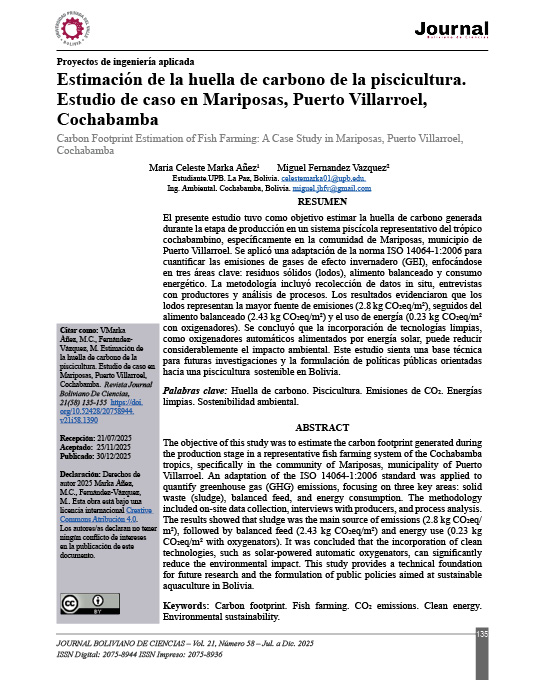
The objective of this study was to estimate the carbon footprint generated during the production stage in a representative fish farming system of the Cochabamba tropics, specifically in the community of Mariposas, municipality of Puerto Villarroel. An adaptation of the ISO 14064-1:2006 standard was applied to quantify greenhouse gas (GHG) emissions, focusing on three key areas: solid waste (sludge), balanced feed, and energy consumption. The methodology included on-site data collection, interviews with producers, and process analysis. The results showed that sludge was the main source of emissions (2.8 kg CO₂eq/m²), followed by balanced feed (2.43 kg CO₂eq/m²) and energy use (0.23 kg CO₂eq/m² with oxygenators). It was concluded that the incorporation of clean technologies, such as solar-powered automatic oxygenators, can significantly reduce the environmental impact. This study provides a technical foundation for future research and the formulation of public policies aimed at sustainable aquaculture in Bolivia.
Downloads
References
Bennardi, D. O. (2020). Digestión anaeróbica: Obtención de biogás.
Bhatia, A. (2014). Biogas production. In History, feedstock and principle of anaerobic digestion. Springer. https://doi.org/10.1007/978-3-319-13523-3
Boyd, C. E. (2022, January 2). Tasa de conversión alimenticia y los beneficios de reducirla. Global Seafood Alliance. https://www.globalseafood.org/advocate/un-bajo-indice-de-conversion-alimenticia-es-el-principal-indicador-de-una-acuacultura-eficiente/
Comité Nacional de Despacho de Carga. (2022). Cálculo del factor de emisión de CO₂ del Sistema Interconectado Nacional: Gestión 2021. CNDC.
Food and Agriculture Organization of the United Nations. (2009). Consecuencias del cambio climático para la pesca y la acuicultura. FAO. https://www.fao.org/3/i0994s/i0994s.pdf
Food and Agriculture Organization of the United Nations. (2013). Enfrentando el cambio climático a través de la ganadería: Una evaluación global de las emisiones y oportunidades de mitigación (P. J. Gerber et al., Eds.). FAO. https://www.fao.org/4/i3437s/i3437s.pdf
Food and Agriculture Organization of the United Nations. (2024). El estado mundial de la pesca y la acuicultura 2024. FAO. https://www.fao.org/publications/fao-flagship-publications/the-state-of-world-fisheries-and-aquaculture/es
Instituto para la Diversificación y Ahorro de la Energía. (2007). Biomasa: Digestores anaerobios. IDAE. https://www.idae.es/uploads/documentos/documentos_10737_Biomasa_Digestores_Anaerobios_A2007_0d62926d.pdf
Instituto Nacional de Ecología y Cambio Climático. (n.d.). Factores de emisión para los diferentes tipos de combustibles fósiles y alternativos que se consumen en México. http://www.inecc.gob.mx
Intergovernmental Panel on Climate Change, & U.S. Environmental Protection Agency. (1990). Emisiones globales de metano antropogénico (Figura 3) y global mitigation of non-CO₂ greenhouse gases. https://www.epa.gov/climatechange/economics/international.html
International Organization for Standardization. (s. f.). ISO Online Browsing Platform (OBP). https://www.iso.org/obp/ui
Ladino-Orjuela, G. (2011). Dinámica del carbono en estanques de peces. Orinoquia, 15(1), 48-61. https://www.redalyc.org/pdf/896/89621344006.pdf
https://doi.org/10.22579/20112629.42
Luna Imbacuan, M. A. (2011). Efluentes piscícolas: Características contaminantes, impactos y perspectivas de tratamiento. Journal de Ciencia e Ingeniería, 3(1), 12-15. https://jci.uniautonoma.edu.co/2011/2011-2.pdf
Ministerio de Planificación del Desarrollo. (2021). Plan de Desarrollo Económico y Social (PDES) 2021-2025.
Poore, J., & Nemecek, T. (2018). Reducing food's environmental impacts through producers and consumers. Science, 360(6392), 987-992. https://doi.org/10.1126/science.aaq0216 PMid:29853680
Servicio Agrícola y Ganadero. (2009). Guía de aplicación de lodos de piscicultura en suelos. Gobierno de Chile. https://www.sag.gob.cl/sites/default/files/Guia%20Piscicultura_2009.pdf
Tchobanoglous, G., Stensel, H. D., Tsuchihashi, R., & Burton, F. L. (2014). Wastewater engineering: Treatment and resource recovery (5th ed.). McGraw-Hill Education.
Vásquez Torres, W. (n.d.). Las dietas como factor de impacto sobre la calidad del agua en sistemas de cultivo intensivo de peces. https://revistas.udenar.edu.co/index.php/reipa/article/view/1662
Werkneh, A. A. (2022). Biogas impurities: Environmental and health implications, removal technologies and future perspectives. Heliyon, 8(10), e10929. https://doi.org/10.1016/j.heliyon.2022.e10929 PMid:36299513 PMCid:PMC9589174
Published
How to Cite
Issue
Section
License
Copyright (c) 2025 Marka Áñez, M.C., Fernández Vázquez, M.

This work is licensed under a Creative Commons Attribution 4.0 International License.
Authors who publish with this journal agree to the following terms:
- Authors retain copyright and grant the journal right of first publication with the work simultaneously licensed under a Creative Commons Attribution License 4.0 that allows others to share the work with an acknowledgement of the work's authorship and initial publication in this journal.
- Authors are able to enter into separate, additional contractual arrangements for the non-exclusive distribution of the journal's published version of the work (e.g., post it to an institutional repository or publish it in a book), with an acknowledgement of its initial publication in this journal.
- Authors are permitted and encouraged to post their work online (e.g., in institutional repositories or on their website) prior to and during the submission process, as it can lead to productive exchanges, as well as earlier and greater citation of published work.