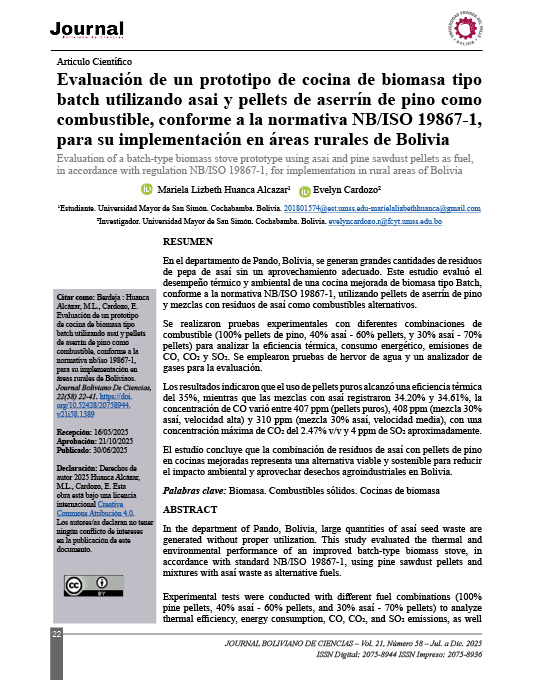
Evaluation of a batch-type biomass stove prototype using asai and pine sawdust pellets as fuel, in accordance with regulation NB/ISO 19867-1, for implementation in rural areas of Bolivia
DOI:
https://doi.org/10.52428/20758944.v21i58.1389Keywords:
Biomass, Solid fuels, Biomass stovesAbstract
In the department of Pando, Bolivia, large quantities of asaí seed waste are generated without proper utilization. This study evaluated the thermal and environmental performance of an improved batch-type biomass stove, in accordance with standard NB/ISO 19867-1, using pine sawdust pellets and mixtures with asaí waste as alternative fuels.
Experimental tests were conducted with different fuel combinations (100% pine pellets, 40% asaí - 60% pellets, and 30% asaí - 70% pellets) to analyze thermal efficiency, energy consumption, CO, CO₂, and SO₂ emissions, as well as particulate matter generation. Water boiling tests and gas analysis were used for evaluation.
The results indicated that the use of pure pellets achieved a thermal efficiency of 35%, while the asaí mixtures recorded 34.20% and 34.61%. In terms of emissions, CO varied between 407 ppm (pure pellets) and 408 ppm (30% asaí mixture High speed) and 310 ppm (30% asaí mixture, medium speed), with a maximum CO₂ concentration of 2.47% v/v and approximately 4 ppm of SO₂.
The study concludes that the combination of asaí waste with pine pellets in improved stoves represents a viable and sustainable alternative to reduce environmental impact and utilize agro-industrial waste in Bolivia.
Downloads
References
Access to clean cooking - SDG7: Data and Projections - Analysis. (s. f.). IEA. Recuperado 23 de septiembre de 2025, de https://www.iea.org/reports/sdg7-data-and-projections/access-to-clean-cooking
Ahmad, R., Zhou, Y., Liang, C., Li, G., Zhao, N., Abbas, A., Yu, F., Li, L., Gong, J., Wang, D., Yang, Y., Tang, Z., Sultan, M., Sun, C., & Dong, R. (2022). Comparative evaluation of thermal and emission performances for improved commercial coal-fired stoves in China. RSC Advances, 12(32), 20886-20896. https://doi.org/10.1039/D2RA03364J PMid:35919151 PMCid:PMC9297129
Barnes, D. F. & Weltbank (Eds.). (1994). What makes people cook with improved biomass stoves? A comparative international review of stove programs. World Bank.
Barpatragohain, R., Bharali, N., & Dutta, P. P. (2021). Thermal Performance Evaluation of an Improved Biomass Cookstove for Domestic Applications. En S. Revankar, S. Sen, & D. Sahu (Eds.), Proceedings of International Conference on Thermofluids (pp. 579-590). Springer Singapore. https://doi.org/10.1007/978-981-15-7831-1_54
Bhusal, P., Ale, B. B., & Singh, R. M. (2015). Performance Evaluation of Domestic Rice Husk Gasifier Stove (Belonio Type) and Study on Modification of Design for using Different Biomass.
Biomass Cookstoves Technical Meeting: Summary Report. (s. f.).
Caubel, J. J., Rapp, V. H., Chen, S. S., & Gadgil, A. J. (2018). Optimization of Secondary Air Injection in a Wood-Burning Cookstove: An Experimental Study. Environmental Science & Technology, 52(7), 4449-4456. https://doi.org/10.1021/acs.est.7b05277 PMid:29554422
Deng, W., Feng, Y., Fu, J., Guo, H., Guo, Y., Han, B., Jiang, Z., Kong, L., Li, C., Liu, H., Nguyen, P. T. T., Ren, P., Wang, F., Wang, S., Wang, Y., Wang, Y., Wong, S. S., Yan, K., Yan, N., … Zhou, H. (2023). Catalytic conversion of lignocellulosic biomass into chemicals and fuels. Green Energy & Environment, 8(1), 10-114. https://doi.org/10.1016/j.gee.2022.07.003
Himanshu, Pal, K., Jain, S., & Tyagi, S. K. (2022). Energy and exergy analysis and emission reduction from forced draft gasifier cookstove models: A comparative study. Journal of Thermal Analysis and Calorimetry, 147(15), 8509-8521. https://doi.org/10.1007/s10973-021-11137-y
Kim, K.-H., Jahan, S. A., & Kabir, E. (2011). A review of diseases associated with household air pollution due to the use of biomass fuels. Journal of Hazardous Materials, 192(2), 425-431. https://doi.org/10.1016/j.jhazmat.2011.05.087 PMid:21705140
Kirch, T., Birzer, C. H., Medwell, P. R., & Holden, L. (2018). The role of primary and secondary air on wood combustion in cookstoves. International Journal of Sustainable Energy, 37(3), 268-277. https://doi.org/10.1080/14786451.2016.1166110
Kshirsagar, M. P., & Kalamkar, V. R. (2014). A comprehensive review on biomass cookstoves and a systematic approach for modern cookstove design. Renewable and Sustainable Energy Reviews, 30, 580-603. https://doi.org/10.1016/j.rser.2013.10.039
Layout 1. (s. f.). Recuperado 23 de septiembre de 2025, de https://cleancooking.org/wp-content/uploads/2021/07/32-1.pdf
Low-cost solutions can give billions access to modern cooking by 2030, but the world is failing to deliver-News. (2023, julio 26). IEA. https://www.iea.org/news/low-cost-solutions-can-give-billions-access-to-modern-cooking-by-2030-but-the-world-is-failing-to-deliver
MacCarty, N., Still, D., & Ogle, D. (2010). Fuel use and emissions performance of fifty cooking stoves in the laboratory and related benchmarks of performance. Energy for Sustainable Development, 14(3), 161-171. https://doi.org/10.1016/j.esd.2010.06.002
McKendry, P. (2002). Energy production from biomass (part 2): Conversion technologies. Bioresource Technology, 83(1), 47-54. https://doi.org/10.1016/S0960-8524(01)00119-5 PMid:12058830
Mekonnen, B. A. (2022). Thermal efficiency improvement and emission reduction potential by adopting improved biomass cookstoves for sauce-cooking process in rural Ethiopia. Case Studies in Thermal Engineering, 38, 102315. https://doi.org/10.1016/j.csite.2022.102315
Pandey, A., Patel, S., Pervez, S., Tiwari, S., Yadama, G., Chow, J. C., Watson, J. G., Biswas, P., & Chakrabarty, R. K. (2017). Aerosol emissions factors from traditional biomass cookstoves in India: Insights from field measurements. Atmospheric Chemistry and Physics, 17(22), 13721-13729. https://doi.org/10.5194/acp-17-13721-2017
(PDF) Effect of holes system designing for low energy stove using coffee husk bio-pellet as solid fuel. (s. f.). ResearchGate. Recuperado 23 de septiembre de 2025, de https://www.researchgate.net/publication/329152217_Effect_of_holes_system_designing_for_low_energy_stove_using_coffee_husk_bio-pellet_as_solid_fuel
Rajkumar, S., Young, B. N., Clark, M. L., Benka-Coker, M. L., Bachand, A. M., Brook, R. D., Nelson, T. L., Volckens, J., Reynolds, S. J., L'Orange, C., Good, N., Koehler, K., Africano, S., Osorto Pinel, A. B., & Peel, J. L. (2019). Household air pollution from biomass-burning cookstoves and metabolic syndrome, blood lipid concentrations, and waist circumference in Honduran women: A cross-sectional study. Environmental Research, 170, 46-55. https://doi.org/10.1016/j.envres.2018.12.010 PMid:30557691 PMCid:PMC6360106
Sharma, M., & Dasappa, S. (2017). Emission reduction potentials of improved cookstoves and their issues in adoption: An Indian outlook. Journal of Environmental Management, 204, 442-453. https://doi.org/10.1016/j.jenvman.2017.09.018 PMid:28917179
Tursi, A. (2019). A review on biomass: Importance, chemistry, classification, and conversion. Biofuel Research Journal, 6(2), 962-979. https://doi.org/10.18331/BRJ2019.6.2.3
Venkataraman, C., Sagar, A. D., Habib, G., Lam, N., & Smith, K. R. (2010). The Indian National Initiative for Advanced Biomass Cookstoves: The benefits of clean combustion. Energy for Sustainable Development, 14(2), 63-72. https://doi.org/10.1016/j.esd.2010.04.005
Westhoff, B., Europäische Kommission, Germann, D., & Rigby, N. (with Commission of the European Community & SfE - Sozietät für Entwicklungsplanung). (1995). Stove images: A documentation of improved and tradional stoves in Africa, Asia and Latin America (1. engl. ed). Brandes und Apsel.
Published
How to Cite
Issue
Section
License
Copyright (c) 2025 Huanca Alcázar, M.L., Cardozo, E.

This work is licensed under a Creative Commons Attribution 4.0 International License.
Authors who publish with this journal agree to the following terms:
- Authors retain copyright and grant the journal right of first publication with the work simultaneously licensed under a Creative Commons Attribution License 4.0 that allows others to share the work with an acknowledgement of the work's authorship and initial publication in this journal.
- Authors are able to enter into separate, additional contractual arrangements for the non-exclusive distribution of the journal's published version of the work (e.g., post it to an institutional repository or publish it in a book), with an acknowledgement of its initial publication in this journal.
- Authors are permitted and encouraged to post their work online (e.g., in institutional repositories or on their website) prior to and during the submission process, as it can lead to productive exchanges, as well as earlier and greater citation of published work.