Participation of women in productive value chains in Bolivia: A perspective from a gender and intersectional approach
DOI:
https://doi.org/10.52428/20758944.v21i58.1385Keywords:
Women, Gender, Intersectionality, Participation, Renewable energyAbstract
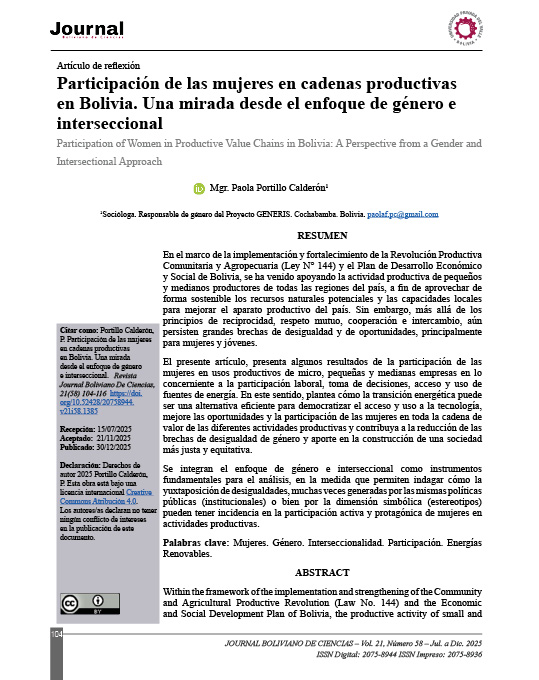
Within the framework of the implementation and strengthening of the Community and Agricultural Productive Revolution (Law No. 144) and the Economic and Social Development Plan of Bolivia, the productive activity of small and medium-sized producers in all regions of the country has been supported, in order to sustainably take advantage of potential natural resources and local capacities to improve the country's productive apparatus. However, beyond the principles of reciprocity, mutual respect, cooperation and exchange, large gaps of inequality and opportunities still persist, mainly for women and young people.
This article presents some results of women's participation in productive uses of micro, small and medium-sized enterprises regarding labor participation, decision making, access and use of energy sources. In this sense, it suggests how the energy transition can be an efficient alternative to democratize access and use of technology, improve the opportunities and participation of women throughout the value chain of different productive activities; but above all, it can close gender inequality gaps and contribute to the construction of a more just and equitable society.
The gender and intersectional approach are integrated as fundamental instruments for the analysis, to the extent that they allow to investigate how the juxtaposition of inequalities, often generated by the same public policies (institutional) or by the symbolic dimension (stereotypes) may have an impact on the active and leading participation of women in productive activities.
Downloads
References
Aledo, A., & Domínguez Gómez, J. A. (2001). Sociología ambiental. Grupo Editorial Universitario. https://rua.ua.es/dspace/handle/10045/2725
Food and Agriculture Organization of the United Nations. (2016). El rol de la mujer en la pesca y la acuicultura (Nota de orientación). FAO. https://www.fao.org/family-farming/detail/es/c/881805/
Peña Legazkue, I., Guerrero, M., González, J., & Montero, J. (2019). Global Entrepreneurship Monitor (GEM): Informe GEM España 2019-2020. Observatorio del Emprendimiento de España. https://observatoriodelemprendimiento.es/gem-spain/wp-content/uploads/2020/06/Informe-GEM-Espa%C3%B1a-2019_20.pdf https://doi.org/10.22429/Euc2020.024
Estado Plurinacional de Bolivia. (2011). Ley N.º 144 de Revolución Productiva Comunitaria Agropecuaria (26 de junio de 2011). https://www.insa.gob.bo/images/normativa/LEYES/LEY_144-Ley_de_Revolucion_Productiva_Comunitaria_Agropecuaria.pdf
Urquidi, M., Tejerina Camacho, V., Raphael, M., & Durand, G. (2020). Trabajar y ser mujer en Bolivia. https://doi.org/10.18235/0002914 PMCid:PMC7454451
Encuesta nacional MIPYMES, energías renovables y usos productivos. (2023).
Published
How to Cite
Issue
Section
License
Copyright (c) 2025 Portillo Calderón, P.

This work is licensed under a Creative Commons Attribution 4.0 International License.
Authors who publish with this journal agree to the following terms:
- Authors retain copyright and grant the journal right of first publication with the work simultaneously licensed under a Creative Commons Attribution License 4.0 that allows others to share the work with an acknowledgement of the work's authorship and initial publication in this journal.
- Authors are able to enter into separate, additional contractual arrangements for the non-exclusive distribution of the journal's published version of the work (e.g., post it to an institutional repository or publish it in a book), with an acknowledgement of its initial publication in this journal.
- Authors are permitted and encouraged to post their work online (e.g., in institutional repositories or on their website) prior to and during the submission process, as it can lead to productive exchanges, as well as earlier and greater citation of published work.